
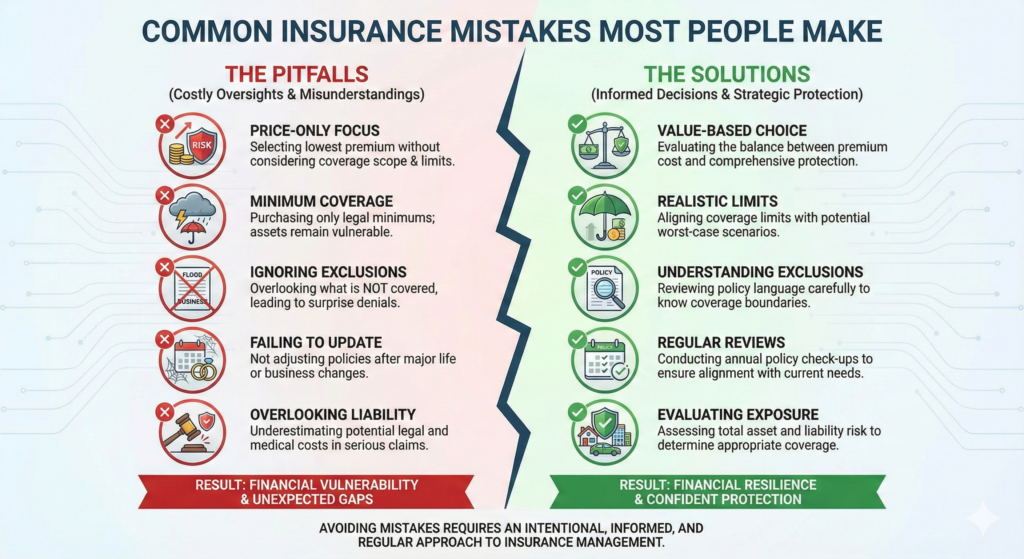
Insurance is designed to protect against financial risk. However, many individuals and business owners make avoidable mistakes when purchasing or managing their policies. These errors often stem from misunderstandings, rushed decisions, or focusing too heavily on cost instead of coverage.
The consequences of insurance mistakes may not become apparent until a claim occurs. At that point, coverage gaps can lead to unexpected out-of-pocket expenses or denied claims.
Understanding the most common insurance mistakes helps individuals and businesses make informed decisions and build stronger financial protection strategies.
1. Choosing Insurance Based Solely on Price
One of the most common mistakes is selecting a policy purely because it offers the lowest premium.
While affordability is important, a lower premium often corresponds to:
- Higher deductibles
- Lower coverage limits
- More exclusions
- Narrower policy terms
Focusing only on cost may result in insufficient protection during major claims.
Insurance should be evaluated based on value — the balance between premium cost and coverage scope.
2. Purchasing Only the Minimum Required Coverage
In areas such as auto insurance, states require minimum liability limits. However, these minimums may not reflect realistic financial exposure.
Medical expenses and legal settlements can exceed state minimums quickly in serious accidents.
Purchasing only minimum required coverage may satisfy legal obligations but leave personal assets vulnerable.
Evaluating potential worst-case scenarios helps determine appropriate coverage limits.
3. Ignoring Policy Exclusions
Insurance policies clearly outline what is not covered. Many policyholders overlook exclusions during the purchase process.
Common examples include:
- Flood damage excluded from standard homeowners policies
- Business activities excluded from personal auto policies
- Certain professional services excluded from general liability
Failing to review exclusions can create significant surprises during claims.
Understanding exclusions is as important as understanding coverage.
4. Underestimating Replacement Costs
For homeowners and business property owners, underestimating replacement costs is a frequent mistake.
Property insurance typically covers the cost to rebuild or replace — not the market value of the property.
If coverage limits are set too low, the policyholder may need to cover the remaining costs after a loss.
Accurate valuation ensures adequate financial protection.
5. Failing to Update Coverage After Life Changes
Insurance needs evolve over time. Common life events that require policy updates include:
- Marriage
- Divorce
- Having children
- Purchasing a home
- Starting a business
- Significant income changes
Failing to adjust coverage after major life changes can result in outdated protection.
Regular policy reviews ensure coverage remains aligned with current responsibilities.
6. Overlooking Liability Coverage
Many people focus on protecting physical assets but underestimate liability risk.
Liability claims can arise from:
- Accidents at home
- Car collisions
- Professional services
- Product-related incidents
In severe cases, legal claims can exceed standard policy limits.
Evaluating liability exposure carefully helps avoid financial vulnerability.
7. Not Understanding Deductibles
A deductible represents the amount the policyholder must pay before insurance coverage applies.
Choosing a high deductible can reduce premiums but may create financial strain during a claim.
Conversely, selecting a very low deductible may increase premiums unnecessarily.
Balancing deductible levels with available savings is essential.
8. Overlapping or Duplicate Coverage
Another common mistake is purchasing multiple policies that overlap in coverage.
For example:
- Buying rental car coverage through both auto insurance and travel insurance
- Having duplicate health coverage without understanding coordination of benefits
Overlapping policies may increase premiums without providing additional benefit.
Careful review of policy terms prevents redundancy.
9. Misrepresenting Information During Application
Insurance applications require accurate information.
Providing incomplete or incorrect details — whether intentional or accidental — can result in:
- Claim denial
- Policy cancellation
- Coverage rescission
Honest disclosure ensures policy validity and avoids disputes.
10. Not Reviewing Policies Annually
Insurance policies often renew automatically. However, renewal does not guarantee optimal coverage.
Annual review allows policyholders to:
- Adjust coverage limits
- Update beneficiaries
- Modify deductibles
- Compare options
Regular review keeps insurance aligned with changing circumstances.
11. Assuming “Full Coverage” Means Complete Protection
The term “full coverage” is often misunderstood. It is not a formal insurance definition.
For example, in auto insurance, “full coverage” typically refers to liability, collision, and comprehensive coverage — but it does not mean every possible scenario is covered.
Understanding specific policy details is more important than relying on informal terminology.
12. Ignoring Business Insurance Needs
Entrepreneurs and freelancers sometimes assume personal insurance policies extend to business activities.
However, personal policies often exclude business-related claims.
Failing to separate personal and business insurance can create significant exposure.
Business operations should have dedicated coverage structures.
13. Delaying Claims Reporting
When an incident occurs, prompt reporting is important.
Delays in reporting can complicate investigations and potentially affect claim outcomes.
Understanding reporting requirements ensures smoother claims processing.
14. Not Considering Umbrella Coverage
Individuals with significant assets may overlook umbrella insurance, which provides additional liability protection beyond standard policy limits.
While not necessary for everyone, umbrella coverage can provide an added layer of protection in high-liability scenarios.
Evaluating total asset exposure helps determine whether additional protection is appropriate.
15. Assuming Insurance Covers Maintenance Issues
Insurance covers sudden and accidental losses — not normal wear and tear or maintenance issues.
For example:
- A roof damaged by a storm may be covered
- A roof deteriorating due to age may not
Confusing maintenance with insurable events is a frequent misunderstanding.
How to Avoid Insurance Mistakes
Avoiding insurance mistakes involves a structured approach:
- Review policy documents carefully
- Compare coverage limits, not just premiums
- Assess realistic risk exposure
- Update policies regularly
- Seek clarification when terms are unclear
Insurance works best when policyholders understand their coverage.
Insurance as a Strategic Financial Tool
Insurance should not be treated as a transactional purchase. It is part of a broader financial planning framework.
Properly structured coverage:
- Protects assets
- Preserves income
- Manages liability exposure
- Supports long-term stability
Mistakes often occur when insurance is viewed as a mandatory expense rather than a strategic safeguard.
Conclusion
Common insurance mistakes often stem from misunderstanding policy details, focusing exclusively on price, or failing to update coverage as circumstances change.
By evaluating coverage limits, reviewing exclusions, understanding deductibles, and aligning insurance with real-world risk, individuals and businesses can avoid costly gaps.
Insurance is most effective when it is intentional, informed, and regularly reviewed. Avoiding common mistakes strengthens financial resilience and ensures coverage performs as expected when needed.