
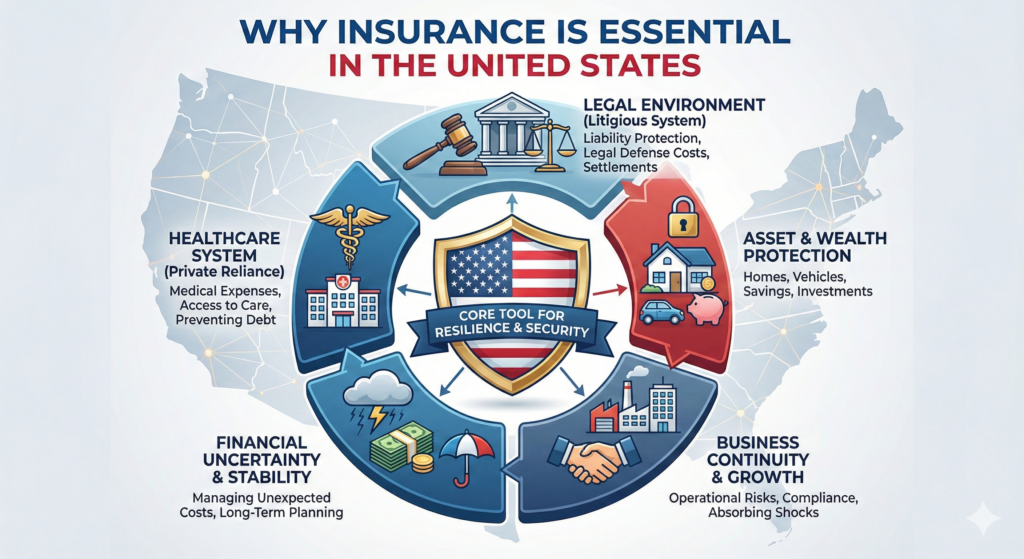
In the United States, insurance is not just a financial product — it is a fundamental part of everyday life. From driving a car to owning a home, starting a business, or accessing healthcare, insurance plays a central role in how society functions. While many people view insurance as an obligation or an expense, its importance goes far deeper than legal compliance.
Understanding why insurance is essential in the US requires looking at the country’s legal system, healthcare structure, economic environment, and cultural approach to risk. Together, these factors make insurance not only useful, but often indispensable.
A Highly Litigious Legal Environment
One of the most important reasons insurance is essential in the United States is the legal landscape. The US is known for having a highly litigious system, where lawsuits are common and financial damages can be significant.
If an individual causes an accident, injury, or financial harm to another party, they may be held legally responsible. Without insurance, the cost of legal defense, settlements, or court judgments can be overwhelming. Liability insurance exists specifically to address this risk.
Auto insurance, professional liability insurance, and general liability insurance are all designed to protect individuals and businesses from the financial consequences of legal claims. In many cases, insurance is the difference between a manageable situation and long-term financial ruin.
Insurance and Everyday Legal Requirements
In the United States, insurance is often required by law. These requirements are not arbitrary; they exist to protect both individuals and society as a whole.
For example:
- Auto insurance is mandatory in most states to ensure drivers can cover damages they cause.
- Workers’ compensation insurance is required for businesses to protect employees injured on the job.
- Professional insurance is often required for licensed occupations.
These requirements create a baseline level of financial responsibility, reducing the burden on courts, healthcare systems, and public resources.
The Structure of the US Healthcare System
Unlike many countries with universal healthcare, the US healthcare system relies heavily on private insurance. Medical care can be extremely expensive, even for routine procedures or short hospital stays.
Health insurance helps individuals manage these costs by spreading expenses across a large population. Without coverage, medical bills can quickly escalate into unmanageable debt. For many Americans, health insurance is essential not only for treatment, but for financial survival.
Insurance also plays a role in preventive care, encouraging regular checkups and early treatment, which can reduce long-term costs for both individuals and the system as a whole.
Protecting Assets and Personal Wealth
In the United States, individuals are often personally responsible for protecting their assets. Homes, vehicles, savings, and investments can all be exposed to risk without proper insurance coverage.
Homeowners insurance protects property against damage from events such as fires, storms, or theft. Auto insurance protects both vehicles and personal liability. Umbrella and liability policies provide additional layers of protection for higher-value assets.
From a strategic perspective, insurance is one of the most effective ways to preserve long-term wealth in an unpredictable environment.
Insurance and Business Survival
For businesses operating in the US, insurance is essential to continuity and stability. Companies face risks from lawsuits, property damage, employee injuries, cyber incidents, and operational disruptions.
Business insurance allows companies to absorb these shocks without shutting down. In many industries, having proper insurance is also a requirement for contracts, partnerships, or regulatory compliance.
From an entrepreneurial viewpoint, insurance is not simply a cost — it is part of the infrastructure that allows businesses to take calculated risks and grow.
Managing Financial Uncertainty
Life in the United States involves significant financial uncertainty. Income, healthcare costs, housing expenses, and legal exposure can change rapidly due to unexpected events.
Insurance provides a structured way to manage this uncertainty. By paying predictable premiums, individuals and businesses protect themselves from unpredictable losses. This stability supports long-term planning, borrowing, investment, and economic participation.
Without insurance, financial decisions become far more conservative, limiting opportunity and growth.
Cultural Attitudes Toward Risk and Responsibility
The US places a strong emphasis on personal responsibility. Individuals are generally expected to manage their own risks rather than rely on government assistance.
Insurance aligns with this cultural framework by offering a private solution to risk management. It allows people to take responsibility for protecting themselves, their families, and others who may be affected by their actions.
This cultural expectation further reinforces the importance of insurance across all aspects of American life.
The Role of Insurance in Economic Stability
Beyond individuals and businesses, insurance supports the broader economy. By absorbing losses and distributing risk, insurance companies help stabilize markets after disasters, accidents, or economic disruptions.
Without insurance, recovery from large-scale events would be slower and more dependent on public funds. Insurance enables faster rebuilding and reduces systemic risk.
Technology and Access to Insurance
Technology has made insurance more accessible and easier to understand. Online platforms, digital tools, and automated processes allow consumers to compare policies, manage coverage, and file claims more efficiently.
This increased accessibility has expanded insurance adoption and improved transparency, reinforcing its role as a foundational component of modern life in the United States.
Why Insurance Is Not Optional in the US
In practical terms, insurance in the United States is not optional. The combination of legal exposure, healthcare costs, asset ownership, and economic responsibility makes insurance essential for financial stability.
While coverage needs vary by individual and situation, the absence of insurance almost always increases vulnerability to financial hardship.
Conclusion
Insurance is essential in the United States because it supports legal responsibility, protects assets, enables healthcare access, and stabilizes both personal and economic risk. It allows individuals and businesses to function confidently in a complex and unpredictable environment.
Rather than viewing insurance as an unnecessary expense, it should be understood as a core tool for resilience, responsibility, and long-term security.