
Insurance premiums can vary significantly from one person to another — even when the coverage appears similar. Many policyholders are surprised to learn that small differences in profile, behavior, or location can influence pricing.
Understanding what affects your insurance rates the most is essential for making informed decisions. It allows you to evaluate quotes more effectively and understand why pricing may change over time.
This guide explains the main factors that influence insurance rates in the United States, based on how insurers assess risk.
This article is for informational purposes only and does not constitute financial, legal, or insurance advice.
The Foundation: Risk-Based Pricing
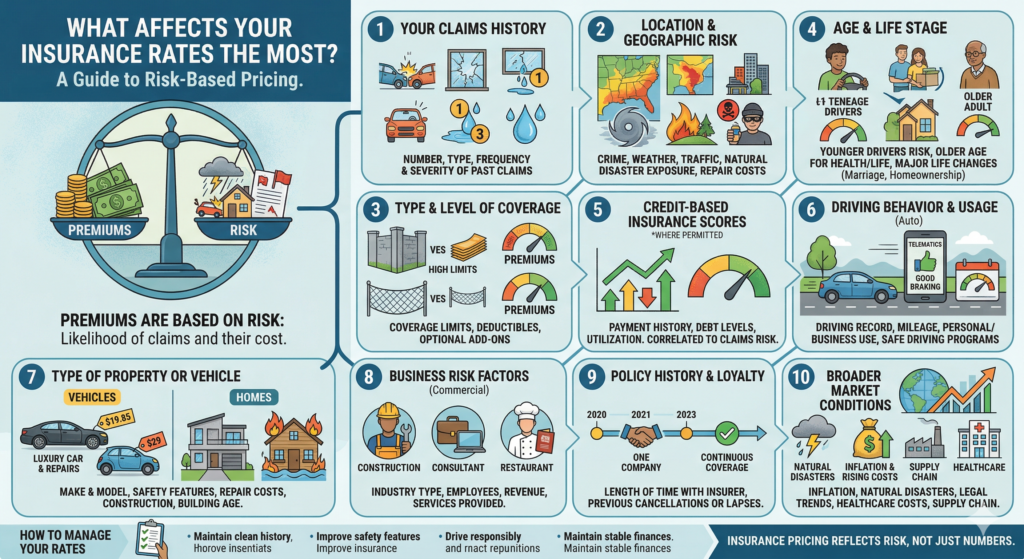
Insurance companies use risk-based pricing models.
This means premiums are calculated based on the likelihood that a policyholder will file a claim and the potential cost of that claim.
Instead of pricing policies randomly, insurers analyze patterns across large groups of people and businesses.
The higher the perceived risk, the higher the premium is likely to be.
1. Your Claims History
One of the most influential factors in determining insurance rates is your claims history.
Insurers evaluate:
- Number of past claims
- Type of claims
- Frequency of claims
- Severity of losses
A history of frequent claims may signal higher future risk.
Even small claims can influence how insurers assess your profile.
For example, multiple minor auto claims over a short period may increase premiums more than a single larger claim.
2. Location and Geographic Risk
Where you live or operate your business plays a major role.
Insurance companies analyze geographic data such as:
- Crime rates
- Traffic density
- Weather patterns
- Natural disaster exposure
- Local repair costs
For instance:
- Urban areas may have higher auto insurance rates due to traffic and theft risk
- Coastal regions may face higher property insurance costs due to hurricanes
- Areas prone to wildfires or flooding may see increased premiums
Location is often one of the most significant pricing variables.
3. Type and Level of Coverage
The structure of your policy directly affects your premium.
Key elements include:
- Coverage limits
- Deductible amount
- Optional add-ons or endorsements
- Type of insurance policy
Higher coverage limits typically increase premiums because the insurer takes on greater financial responsibility.
Higher deductibles may reduce premiums, as the policyholder retains more risk.
Understanding this balance is essential when comparing policies.
4. Age and Life Stage
Age is a common factor in many types of insurance.
For example:
- Younger drivers may face higher auto insurance premiums due to statistical risk patterns
- Older individuals may see different pricing structures in health or life insurance
Life stage also influences risk exposure.
Major life changes — such as marriage, homeownership, or starting a business — may impact coverage needs and pricing.
5. Credit-Based Insurance Scores (Where Permitted)
In many states, insurers use credit-based insurance scores as part of their pricing models.
These scores are not the same as credit scores used for lending, but they may reflect:
- Payment history
- Debt levels
- Credit utilization
- Length of credit history
Statistical models suggest a correlation between credit behavior and claims risk.
However, regulations vary by state, and not all insurers use this factor.
6. Driving Behavior and Usage (Auto Insurance)
For auto insurance, driving behavior is a major factor.
Insurers may evaluate:
- Driving record (accidents, violations)
- Mileage
- Vehicle usage (personal vs business)
- Participation in telematics programs
Telematics programs use devices or mobile apps to track:
- Speed patterns
- Braking behavior
- Time of day driving
- Distance traveled
Safer driving behavior may result in more favorable pricing under certain programs.
7. Type of Property or Vehicle
The characteristics of what you are insuring also affect pricing.
For Vehicles:
- Make and model
- Safety features
- Repair costs
- Theft rates
For Homes or Property:
- Construction materials
- Age of the building
- Location risk
- Replacement cost
- Security features
Higher replacement costs generally increase premiums.
8. Business Risk Factors (For Commercial Insurance)
For business insurance, pricing depends heavily on operational risk.
Factors include:
- Industry type
- Number of employees
- Revenue size
- Physical location
- Type of services provided
- Contractual obligations
For example, a construction company faces different risks than a consulting firm.
Insurance pricing reflects those differences.
9. Policy History and Loyalty
Some insurers consider policy history, including:
- Length of time with the insurer
- Continuous coverage
- Previous cancellations or lapses
However, loyalty does not always guarantee lower premiums.
Market conditions and updated risk models may lead to pricing changes over time.
10. Broader Market Conditions
Insurance rates are also influenced by factors beyond individual control.
These include:
- Inflation and rising repair costs
- Increased frequency of natural disasters
- Legal environment and claim trends
- Healthcare cost increases
- Supply chain disruptions
These macro-level trends affect entire groups of policyholders, not just individuals.
Common Misconceptions About Insurance Rates
Misconception 1: “All Insurers Use the Same Pricing Model”
Different insurers use different data sets and models. This is why quotes can vary significantly.
Misconception 2: “Only Age and Location Matter”
While important, many additional variables — such as behavior, claims history, and coverage choices — also play a major role.
Misconception 3: “The Lowest Price Is Always the Best Option”
Lower premiums may come with:
- Higher deductibles
- Lower coverage limits
- More exclusions
Evaluating overall policy structure is essential.
How to Manage and Potentially Influence Your Rates
While not all factors are controllable, some actions may help improve your risk profile:
- Maintain a clean claims history when possible
- Choose deductibles aligned with your financial capacity
- Review coverage regularly
- Improve property safety features
- Drive responsibly (for auto insurance)
- Maintain stable financial habits
These steps do not guarantee lower premiums but may contribute to more favorable pricing over time.
Why Rates Change Over Time
Even if your personal situation remains stable, insurance rates may change due to:
- Updated actuarial models
- Market-wide risk trends
- Regulatory adjustments
- Economic conditions
Regular policy reviews help ensure your coverage remains aligned with your needs.
Final Thoughts
Insurance rates are influenced by a combination of personal factors, behavioral patterns, geographic risk, and broader market conditions.
Understanding these variables helps explain why premiums differ and why they may change over time.
Rather than focusing solely on cost, evaluating the full structure of a policy — including coverage limits, deductibles, and exclusions — leads to more informed decisions.
Insurance pricing reflects risk, not just numbers. The more you understand how that risk is evaluated, the better equipped you are to choose coverage that fits your situation.