
Starting a business is an exciting process, especially for first-time founders. From building a product to finding customers, most of the focus is on growth and innovation. However, one critical area is often underestimated: insurance.
For startups, insurance is not just a formality — it is a key part of risk management. Without the right coverage, a single unexpected event could disrupt operations or create financial strain.
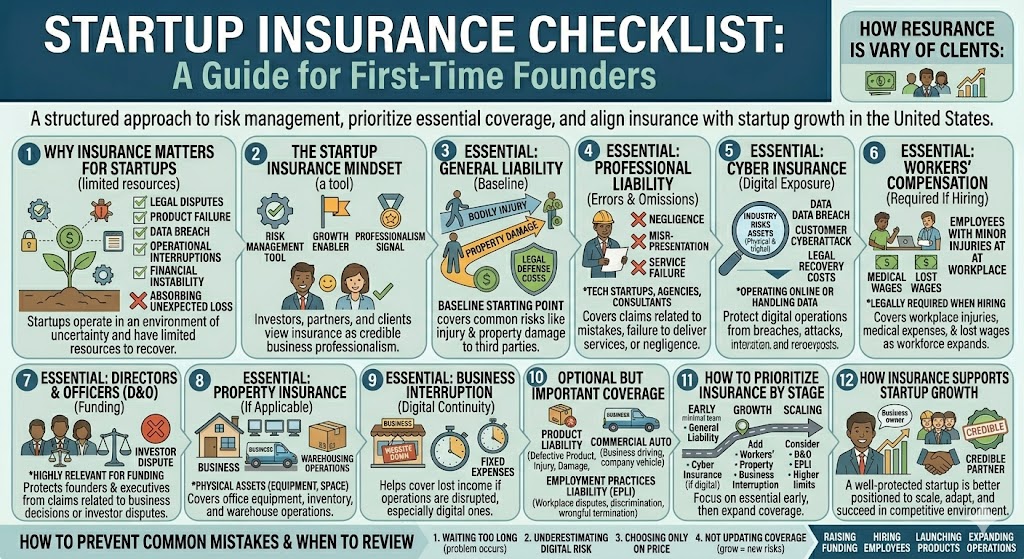
This startup insurance checklist is designed to help first-time founders understand what coverage they may need, how to prioritize it, and how to align insurance with business growth.
This article is for informational purposes only and does not constitute legal or insurance advice.
Why Insurance Matters for Startups
Startups operate in an environment of uncertainty.
Common risks include:
- Legal disputes
- Product or service failures
- Data breaches
- Operational interruptions
- Financial instability
Unlike established businesses, startups often have limited resources to absorb unexpected losses.
Insurance helps reduce that uncertainty.
The Startup Insurance Mindset
Before choosing policies, founders should shift how they think about insurance.
It is not just:
- A cost
- A requirement
It is:
- A risk management tool
- A growth enabler
- A signal of professionalism
Investors, partners, and clients may view insurance as part of business credibility.
The Essential Startup Insurance Checklist
1. General Liability Insurance
This is often the starting point for most businesses.
It may cover:
- Third-party bodily injury
- Property damage
- Legal defense costs
Even early-stage startups can face liability risks.
2. Professional Liability (Errors & Omissions)
Critical for startups offering services or digital products.
It covers claims related to:
- Mistakes
- Failure to deliver services
- Negligence
For tech startups, agencies, and consultants, this is often essential.
3. Cyber Insurance
For startups operating online or handling data, this is one of the most important coverages.
It may include:
- Data breach response
- Cyberattack recovery
- Business interruption
- Legal costs
As digital operations grow, so does exposure.
4. Workers’ Compensation (If Hiring Employees)
Once a startup hires employees, this is often legally required.
It covers:
- Workplace injuries
- Medical expenses
- Lost wages
Requirements vary by state.
5. Directors and Officers (D&O) Insurance
Highly relevant for startups seeking funding.
It protects founders and executives from claims related to:
- Business decisions
- Investor disputes
- Regulatory issues
Investors may require this before funding.
6. Property Insurance (If Applicable)
If the startup owns or leases physical assets:
- Equipment
- Office space
- Inventory
Property insurance helps protect against loss or damage.
7. Business Interruption Insurance
Startups often rely on continuous operations.
This coverage may help if:
- Operations are disrupted
- Revenue is temporarily lost
Particularly relevant for digital businesses.
Optional but Important Coverage
1. Product Liability Insurance
For startups selling physical products.
Covers claims related to:
- Defective products
- Injury or damage caused by products
2. Commercial Auto Insurance
If vehicles are used for business purposes.
3. Employment Practices Liability Insurance (EPLI)
Covers claims related to:
- Wrongful termination
- Discrimination
- Workplace disputes
As teams grow, this becomes more relevant.
How to Prioritize Insurance as a Founder
Not every startup needs every policy immediately.
Prioritization depends on:
- Business model
- Industry
- Stage of growth
- Risk exposure
Early Stage (Pre-Revenue or Small Teams)
Focus on:
- General liability
- Professional liability (if applicable)
- Cyber insurance (for digital startups)
Growth Stage
Add:
- Workers’ compensation
- Property insurance
- Business interruption
Scaling Stage
Consider:
- D&O insurance
- EPLI
- Higher coverage limits
Common Mistakes First-Time Founders Make
1. Waiting Too Long
Many founders delay insurance until a problem occurs.
2. Underestimating Digital Risk
Cyber threats are often overlooked early on.
3. Choosing Coverage Based Only on Price
Lower premiums may mean reduced protection.
4. Not Updating Coverage
As startups grow, their risk profile changes.
Real-World Example
A startup launches a SaaS platform.
Initially:
- It operates with minimal coverage
As it grows:
- It stores customer data → cyber risk increases
- It signs contracts → liability exposure increases
- It raises funding → D&O becomes relevant
Without updating insurance, the startup may face significant gaps.
How Insurance Supports Startup Growth
Insurance is not just about protection.
It also helps:
- Build trust with clients
- Meet contractual requirements
- Attract investors
- Reduce uncertainty
For startups, this can be a competitive advantage.
The Role of Technology in Startup Insurance
Modern insurance solutions are evolving to support startups.
These may include:
- Flexible, on-demand coverage
- Digital policy management
- Data-driven risk assessment
- Scalable pricing models
This aligns well with the fast-paced nature of startups.
When to Review Your Insurance
Startups should review coverage:
- After raising funding
- When hiring employees
- When launching new products
- When expanding operations
Regular review helps ensure alignment with growth.
Final Thoughts
For first-time founders, insurance may not seem like a priority compared to product development or growth.
However, it plays a critical role in protecting the business from unexpected risks.
Using a structured checklist helps ensure that essential coverage is in place and evolves alongside the startup.
Insurance is not just about avoiding problems — it is about building a foundation for sustainable growth.
A well-protected startup is better positioned to scale, adapt, and succeed in a competitive environment.