
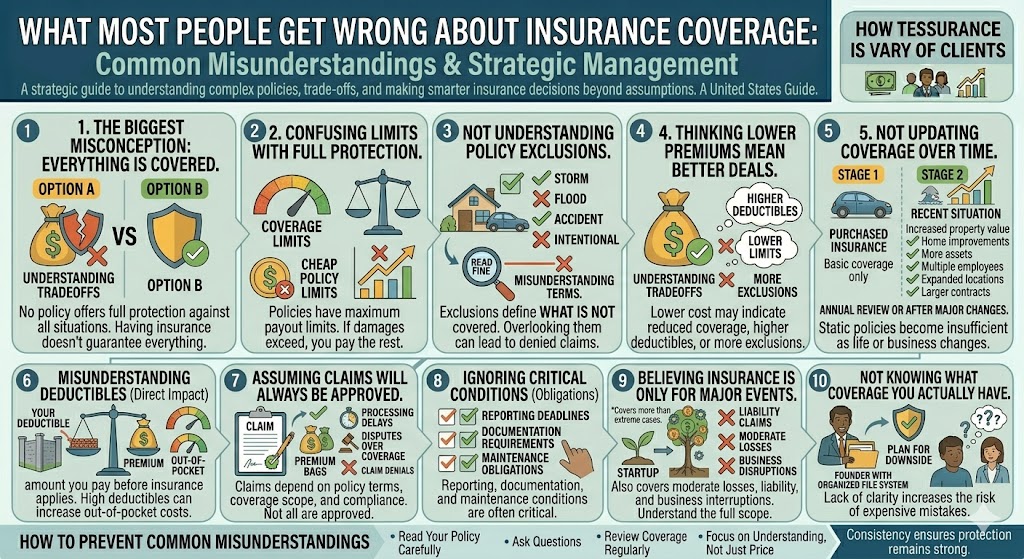
Insurance coverage is one of the most important aspects of financial protection — yet it is also one of the most misunderstood.
Many people believe they are properly covered, only to realize during a claim that their assumptions were incorrect. These misunderstandings can lead to unexpected costs, denied claims, or serious financial consequences.
The problem is not usually a lack of insurance — it is a lack of understanding.
This guide explains what most people get wrong about insurance coverage and how to avoid these common mistakes.
This article is for informational purposes only and does not constitute financial, legal, or insurance advice.
Why Insurance Coverage Is So Often Misunderstood
Insurance policies are complex by design.
They include:
- Technical language
- Detailed conditions
- Specific exclusions
- Structured limits
Because of this, many people:
- Focus only on the price
- Skip reading policy details
- Rely on assumptions or general advice
This creates a gap between what they think is covered and what actually is.
The Most Common Misunderstandings About Insurance Coverage
1. “If I Have Insurance, Everything Is Covered”
This is one of the biggest misconceptions.
Reality:
Every policy has limitations.
Coverage depends on:
- Specific risks included
- Defined conditions
- Policy exclusions
Having insurance does not mean full protection against all situations.
2. Confusing Coverage Limits with Full Protection
Many people assume their policy will cover all costs.
Reality:
Policies have maximum payout limits.
If damages exceed those limits:
- You are responsible for the remaining costs
This is especially important for liability coverage.
3. Not Understanding Exclusions
Exclusions are often overlooked.
These define:
- What is NOT covered
Common issues include:
- Assuming coverage exists when it does not
- Not reviewing exclusions in detail
This is one of the main reasons claims are denied.
4. Thinking Lower Premiums Mean Better Deals
Price is often used as the main comparison factor.
Reality:
Lower premiums may indicate:
- Reduced coverage
- Higher deductibles
- More exclusions
A cheaper policy may provide less real protection.
5. Not Updating Coverage Over Time
Many people keep the same policy for years.
Reality:
Life and business situations change.
Without updates:
- Coverage may become insufficient
- New risks may not be covered
Insurance should evolve with your situation.
6. Misunderstanding Deductibles
The deductible is the amount you pay before insurance applies.
Common misunderstandings include:
- Not knowing the deductible amount
- Not realizing how it affects claims
- Choosing deductibles that are too high or too low
This directly impacts out-of-pocket costs.
7. Assuming Claims Will Always Be Approved
Many people believe that filing a claim guarantees payment.
Reality:
Claims depend on:
- Policy terms
- Coverage scope
- Compliance with conditions
If requirements are not met, claims may be denied.
8. Ignoring Policy Conditions
Conditions are often overlooked but are critical.
They may include:
- Reporting deadlines
- Documentation requirements
- Maintenance obligations
Failing to meet these conditions can affect coverage.
9. Believing Insurance Is Only for Major Events
Some people think insurance only matters in extreme cases.
Reality:
Insurance also covers:
- Moderate losses
- Liability situations
- Business disruptions
Understanding the full scope is important.
10. Not Knowing What Type of Coverage You Actually Have
Many policyholders cannot clearly explain:
- What their policy covers
- What it excludes
- What limits apply
This lack of clarity increases the risk of mistakes.
Real-World Example
Consider a business owner who believes their liability insurance covers all client-related issues.
A claim arises due to a specific situation that falls under an exclusion.
Result:
- Claim is denied
- Business must cover the costs
The issue was not the lack of insurance — it was misunderstanding the coverage.
Why These Mistakes Happen
These misunderstandings are common because:
- Policies are complex
- People rely on simplified explanations
- Important details are overlooked
- Insurance is often treated as a formality
Without proper understanding, assumptions replace facts.
How to Avoid Misunderstanding Insurance Coverage
1. Read Your Policy Carefully
Focus on:
- Coverage details
- Limits
- Exclusions
- Conditions
2. Ask Questions
If something is unclear, clarify before relying on the policy.
3. Review Coverage Regularly
Ensure it reflects your current situation.
4. Focus on Understanding, Not Just Price
Better understanding leads to better decisions.
The Cost of Getting It Wrong
Misunderstanding insurance coverage can lead to:
- Financial losses
- Coverage gaps
- Claim denials
- Increased risk exposure
These issues often appear when it is too late to fix them.
The Strategic Perspective
Understanding insurance coverage is not just about avoiding mistakes — it is about making informed decisions.
Clear knowledge allows you to:
- Align coverage with risk
- Optimize protection
- Reduce uncertainty
- Improve financial stability
For businesses, this is a key part of risk management.
Final Thoughts
Insurance coverage is only effective if it is properly understood.
Many of the most expensive mistakes come from assumptions, not from the absence of insurance.
By taking the time to understand how your policy works — including its limits, exclusions, and conditions — you can avoid common pitfalls and ensure that your coverage provides real protection.
In the end, the value of insurance is not just in having it, but in knowing how it works.