
As businesses become increasingly digital, cyber risk has evolved from a technical concern into a core operational issue. Companies of all sizes — from startups to established enterprises — rely on digital systems for communication, transactions, data storage, and customer engagement. With this reliance comes exposure to cyber threats.
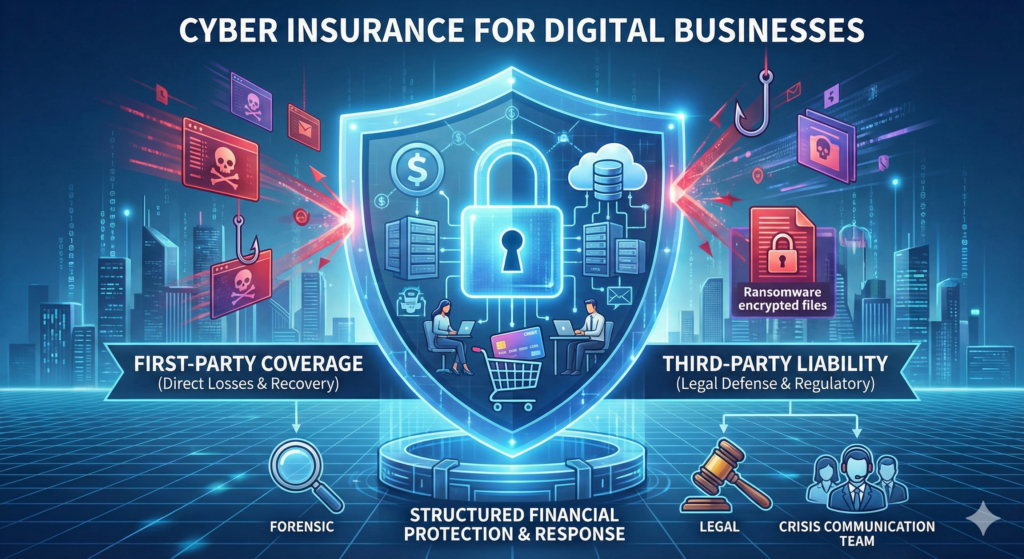
Cyber insurance for digital businesses is designed to help manage the financial consequences of cyber-related incidents such as data breaches, ransomware attacks, and network disruptions. While it does not prevent cyberattacks, it provides structured financial protection and access to professional response resources when incidents occur.
Understanding how cyber insurance works and what it covers is essential for companies operating in today’s technology-driven environment.
Why Digital Businesses Face Unique Cyber Risks
Digital businesses operate in environments where data is central to operations. Whether managing customer information, processing online payments, hosting cloud-based platforms, or running e-commerce systems, digital infrastructure is often mission-critical.
Common cyber risks include:
- Data breaches involving sensitive customer information
- Phishing attacks targeting employees
- Ransomware that encrypts systems and demands payment
- Distributed denial-of-service (DDoS) attacks
- Business email compromise
- Insider threats
For technology companies, SaaS providers, online retailers, and remote-first businesses, even brief system outages can disrupt revenue and customer trust.
Cyber insurance helps mitigate the financial impact of these risks.
What Cyber Insurance Typically Covers
Cyber insurance policies generally include two primary categories of coverage: first-party coverage and third-party liability coverage.
First-Party Coverage
First-party coverage addresses direct losses suffered by the insured business.
This may include:
- Costs related to investigating a data breach
- Data restoration expenses
- Business interruption losses due to network downtime
- Crisis management and public relations services
- Notification costs required by data protection laws
For example, if a company’s customer database is compromised, the policy may help cover forensic analysis, customer notification requirements, and system recovery.
Third-Party Liability Coverage
Third-party coverage applies when external parties claim financial harm due to a cyber incident involving the insured business.
This may include:
- Legal defense costs
- Settlements or judgments
- Regulatory investigations
- Fines and penalties (where legally insurable)
If customers sue a business for failing to protect their personal data, third-party liability coverage may respond according to policy terms.
Why Cyber Insurance Is Increasingly Important
Cyber incidents are no longer limited to large corporations. Small and mid-sized businesses are also targeted, often because they may have fewer cybersecurity resources.
Additionally, regulatory requirements surrounding data privacy have expanded. Laws at state and federal levels may require businesses to notify affected individuals and, in some cases, regulatory authorities after a breach.
The financial impact of these obligations can be significant.
Cyber insurance provides financial structure and access to incident response professionals, helping businesses navigate complex situations more effectively.
Who Needs Cyber Insurance?
Cyber insurance may be particularly relevant for:
- E-commerce companies
- Software and SaaS providers
- Healthcare organizations
- Financial services firms
- Businesses storing customer payment data
- Companies handling personal or confidential information
Even businesses that do not consider themselves “technology companies” may face exposure if they collect customer information online.
The increasing digitalization of business operations makes cyber risk broadly applicable.
How Insurers Evaluate Cyber Risk
Insurance providers assess several factors when underwriting cyber insurance policies:
- Industry type
- Annual revenue
- Data storage practices
- Security protocols
- Employee cybersecurity training
- Use of encryption and multi-factor authentication
- Incident response plans
Companies with documented cybersecurity policies and proactive risk management strategies may be viewed more favorably during underwriting.
Cyber insurance is closely linked to risk management practices.
Common Exclusions in Cyber Insurance Policies
Like all insurance products, cyber insurance policies include exclusions. Common exclusions may include:
- Intentional acts
- Fraud committed by executives
- Failure to maintain minimum security standards
- Pre-existing incidents
Some policies also exclude certain types of infrastructure failures or acts of war.
Careful review of policy language is essential to understand coverage boundaries.
The Role of Business Interruption Coverage in Cyber Policies
One of the most critical components of cyber insurance is business interruption coverage.
If a cyberattack causes systems to go offline, revenue may decline during the downtime. Business interruption coverage may help offset lost income during the recovery period.
For digital-first businesses, system availability directly affects financial performance.
Understanding how downtime is calculated and documented is important when evaluating coverage.
Incident Response and Crisis Management
Many cyber insurance policies include access to incident response teams.
These professionals may assist with:
- Forensic investigation
- Legal compliance guidance
- Public communication strategy
- Negotiation support in ransomware cases
Having structured support during a cyber crisis can help businesses respond more efficiently and reduce long-term impact.
Cyber Insurance and Regulatory Compliance
Data privacy regulations continue to evolve. Businesses operating in the United States may be subject to state-level data breach notification laws and industry-specific regulations.
Cyber insurance policies may include regulatory response coverage, though the insurability of fines varies by jurisdiction.
Insurance does not replace compliance obligations, but it may provide financial assistance when regulatory action follows a cyber incident.
Cyber Insurance for Startups and Technology Companies
Startups and technology companies often handle user data at scale. Investors, partners, and enterprise clients increasingly require proof of cyber insurance before entering into contracts.
For SaaS companies and digital platforms, cyber insurance may:
- Enhance credibility
- Support contractual requirements
- Provide structured risk management
Early-stage companies should assess cyber exposure alongside other foundational business protections.
Cyber Insurance and Risk Mitigation
Insurance should be part of a broader cybersecurity strategy. Businesses should also implement:
- Strong password policies
- Multi-factor authentication
- Regular software updates
- Employee training
- Data encryption
- Secure backup systems
Insurers may require minimum cybersecurity standards as a condition of coverage.
Insurance complements risk mitigation but does not replace it.
The Cost of Cyber Insurance
Cyber insurance premiums vary depending on:
- Business size
- Revenue
- Industry
- Security posture
- Coverage limits selected
Higher coverage limits and broader policy terms typically result in higher premiums.
Cost considerations should be balanced with potential exposure and operational dependency on digital systems.
Reviewing Cyber Insurance Regularly
As businesses grow and adopt new technologies, cyber risk profiles evolve.
Companies should review cyber insurance policies when:
- Launching new digital products
- Expanding into new markets
- Increasing data collection
- Adopting new cloud providers
- Experiencing organizational growth
Regular review ensures that coverage remains aligned with operational realities.
Conclusion
Cyber insurance for digital businesses provides structured financial protection against the consequences of cyber incidents. In an increasingly digital economy, cyber risk affects companies across industries — not only technology firms.
By covering direct losses, liability claims, and incident response costs, cyber insurance helps businesses manage uncertainty in a structured and predictable way.
While it does not eliminate cyber threats, it supports financial resilience and operational continuity when incidents occur. For digital businesses, cyber insurance is no longer optional consideration — it is an important component of comprehensive risk management.