
The insurance industry is undergoing a significant transformation. With the rise of technology, digital insurance has emerged as an alternative to traditional insurance models.
While both aim to provide financial protection, they differ in how they operate, how policies are managed, and how customers interact with providers.
Understanding the key differences between digital insurance and traditional insurance can help you make better decisions when choosing coverage.
This article is for informational purposes only and does not constitute financial or insurance advice.
What Is Traditional Insurance?
Traditional insurance refers to the conventional model where policies are:
- Sold through agents or brokers
- Managed through physical offices or call centers
- Based on standardized processes
- Often reliant on manual underwriting
This model has been used for decades and remains widely adopted.
What Is Digital Insurance?
Digital insurance uses technology to streamline and automate insurance processes.
This includes:
- Online policy purchase
- Automated underwriting
- Mobile apps and digital dashboards
- AI-driven risk assessment
Digital insurance platforms are often associated with “insurtech” companies.
Core Differences Between Digital and Traditional Insurance
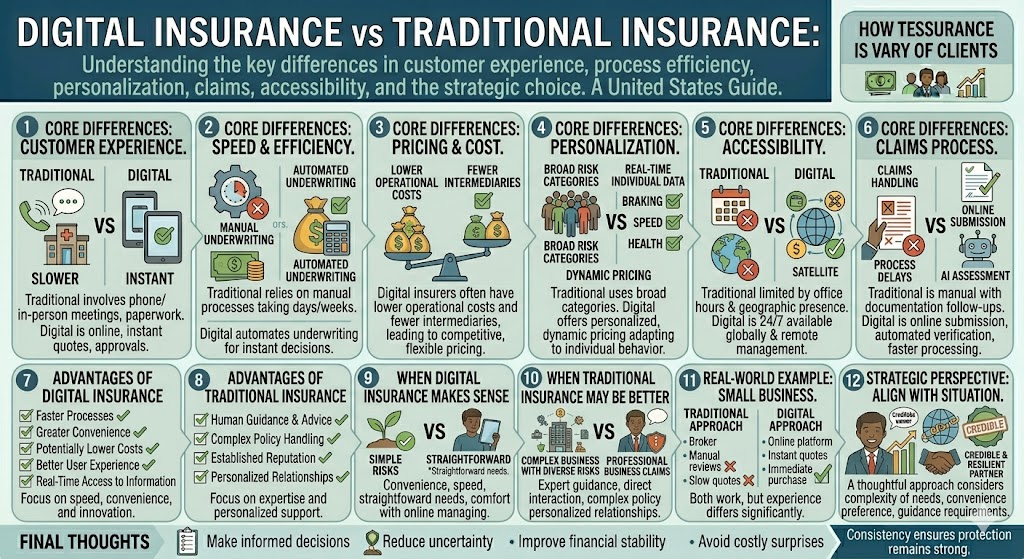
1. Customer Experience
Traditional Insurance:
- Requires phone calls or in-person meetings
- Slower response times
- More paperwork
Digital Insurance:
- Fully online experience
- Instant quotes and approvals
- Easy policy management through apps
Digital platforms prioritize convenience and speed.
2. Speed and Efficiency
Traditional processes can take:
- Days or weeks for approval
- Manual review of applications
Digital insurance can:
- Provide instant quotes
- Automate underwriting
- Reduce processing time significantly
3. Pricing and Cost Structure
Digital insurers often have:
- Lower operational costs
- Fewer intermediaries
This can lead to:
- More competitive pricing
- More flexible pricing models
However, pricing still depends on risk assessment.
4. Personalization
Traditional insurance:
- Uses broader risk categories
- Less dynamic pricing
Digital insurance:
- Uses real-time data
- Offers personalized pricing
- Adapts to individual behavior
This is especially visible in areas like auto or health insurance.
5. Accessibility
Traditional insurance may be limited by:
- Office hours
- Geographic presence
Digital insurance:
- Available 24/7
- Accessible from anywhere
- Easy to manage remotely
6. Claims Process
Traditional Insurance:
- Often manual
- Requires documentation and follow-ups
- Slower processing
Digital Insurance:
- Online claims submission
- Automated verification
- Faster processing times
Some platforms even use AI to assess claims.
7. Transparency
Digital platforms often provide:
- Clear dashboards
- Easy access to policy details
- Real-time updates
Traditional models may rely more on:
- Documents
- Customer service interactions
8. Human Interaction
Traditional insurance offers:
- Direct contact with agents
- Personalized advice
Digital insurance:
- Limited human interaction
- More self-service tools
This can be a benefit or drawback depending on user preference.
Advantages of Digital Insurance
- Faster processes
- Greater convenience
- Potentially lower costs
- Better user experience
- Real-time access to information
Advantages of Traditional Insurance
- Human guidance and advice
- More complex policy handling
- Established reputation
- Personalized relationships
When Digital Insurance Makes More Sense
Digital insurance may be ideal if:
- You prefer convenience and speed
- Your insurance needs are straightforward
- You are comfortable managing policies online
When Traditional Insurance May Be Better
Traditional insurance may be preferable if:
- Your situation is complex
- You need expert guidance
- You value personal interaction
Real-World Example
Consider a small business owner looking for liability insurance.
Traditional approach:
- Contact broker
- Review options manually
- Wait for quotes
Digital approach:
- Use online platform
- Get instant quotes
- Purchase coverage immediately
Both approaches work — but the experience differs significantly.
Challenges of Digital Insurance
Despite its advantages, digital insurance has limitations.
1. Limited Human Support
Not all situations can be easily handled without expert advice.
2. Complexity in Advanced Cases
Complex policies may still require traditional expertise.
3. Data Privacy Concerns
Digital platforms rely heavily on data, raising privacy considerations.
4. Trust and Familiarity
Some users may prefer established, traditional providers.
The Future: A Hybrid Model
The future of insurance is likely a combination of both models.
We are already seeing:
- Traditional insurers adopting digital tools
- Digital platforms adding human support
This hybrid approach aims to combine:
- Efficiency of technology
- Value of human expertise
The Strategic Perspective
Choosing between digital and traditional insurance is not about which is better — it is about which is more appropriate for your situation.
A strategic approach considers:
- Complexity of your needs
- Preference for convenience vs guidance
- Risk profile
- Level of involvement you want
Final Thoughts
Digital insurance and traditional insurance serve the same purpose but operate in very different ways.
Digital insurance offers speed, convenience, and innovation, while traditional insurance provides human expertise and personalized support.
Understanding these differences helps you choose the approach that best fits your needs.
As technology continues to evolve, the gap between the two models will likely narrow — creating more flexible and efficient insurance solutions.