
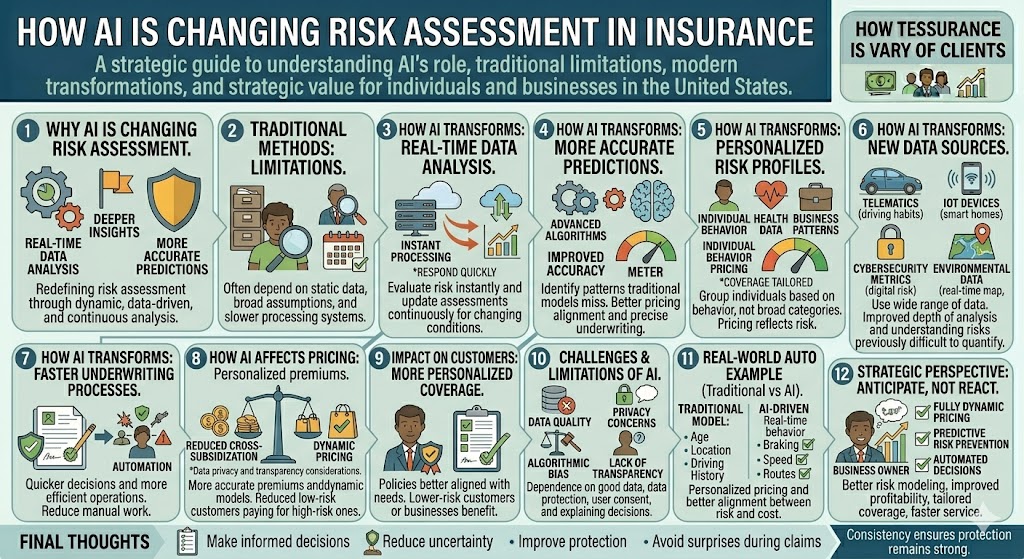
Risk assessment has always been at the core of the insurance industry. Insurers rely on data, historical trends, and statistical models to evaluate the likelihood of events and determine pricing.
However, traditional methods have limitations. They often depend on static data, generalized assumptions, and slower processing systems.
Artificial Intelligence (AI) is transforming this landscape.
By enabling real-time analysis, deeper insights, and more accurate predictions, AI is redefining how risk is assessed in modern insurance.
This shift is not only changing how insurers operate — it is also affecting pricing, coverage, and the overall customer experience.
This article is for informational purposes only and does not constitute financial or insurance advice.
What Is Risk Assessment in Insurance?
Risk assessment is the process insurers use to evaluate:
- The likelihood of a claim
- The potential cost of that claim
- The appropriate pricing (premium)
Traditionally, this process relies on:
- Historical data
- Demographic information
- General risk categories
While effective, these methods can be limited in precision.
The Limitations of Traditional Risk Assessment
Traditional models often:
- Use broad categories instead of individual behavior
- Rely on outdated or static data
- Take longer to process information
- Struggle to adapt quickly to new risks
As a result, pricing and coverage may not always reflect real-time risk.
How AI Is Transforming Risk Assessment
Artificial Intelligence introduces a more dynamic and data-driven approach.
1. Real-Time Data Analysis
AI systems can process large volumes of data instantly.
This allows insurers to:
- Evaluate risk in real time
- Update assessments continuously
- Respond quickly to changing conditions
This is a major shift from static models.
2. More Accurate Risk Predictions
AI uses advanced algorithms and machine learning to identify patterns that traditional models may miss.
This leads to:
- Improved prediction accuracy
- Better pricing alignment
- More precise underwriting
3. Personalized Risk Profiles
Instead of grouping individuals into broad categories, AI enables more personalized assessments.
This means:
- Pricing can reflect individual behavior
- Coverage can be tailored more effectively
Examples include:
- Driving behavior for auto insurance
- Health data for life or health policies
- Business activity patterns for commercial insurance
4. Integration of New Data Sources
AI allows insurers to use a wider range of data.
This may include:
- Telematics data (e.g., driving habits)
- IoT devices (e.g., smart home systems)
- Cybersecurity metrics
- Real-time environmental data
These inputs improve the depth of risk analysis.
5. Faster Underwriting Processes
AI can automate parts of the underwriting process.
This results in:
- Faster policy approvals
- Reduced manual work
- More efficient operations
For customers, this means quicker decisions.
How AI Affects Insurance Pricing
AI-driven risk assessment can lead to:
- More accurate premiums
- Reduced cross-subsidization (low-risk customers paying for high-risk ones)
- Dynamic pricing models
However, it also introduces new considerations, such as:
- Data privacy
- Transparency in pricing decisions
The Impact on Customers
1. More Personalized Coverage
Policies can be better aligned with individual needs and behavior.
2. Potential Cost Savings
Lower-risk individuals or businesses may benefit from more accurate pricing.
3. Faster Processes
Applications, underwriting, and claims can be processed more efficiently.
4. Greater Transparency Challenges
AI models can be complex, making it harder to understand how decisions are made.
AI and Risk in Digital and Tech-Driven Businesses
For modern businesses, especially digital ones, AI plays a key role in evaluating:
- Cyber risk
- Operational risk
- Data exposure
This is particularly relevant for startups and tech companies.
AI helps insurers better understand risks that were previously difficult to quantify.
Challenges and Limitations of AI in Insurance
While AI offers many advantages, it also presents challenges.
1. Data Quality and Availability
AI depends on accurate and relevant data.
Poor data can lead to incorrect assessments.
2. Privacy Concerns
Using more data raises questions about:
- Data protection
- User consent
- Regulatory compliance
3. Algorithmic Bias
AI systems may reflect biases present in the data.
This can impact fairness in pricing and coverage.
4. Lack of Transparency
AI models can be complex and difficult to interpret.
This may create challenges in explaining decisions to customers.
Real-World Example
Consider auto insurance.
Traditional model:
- Based on age, location, and driving history
AI-driven model:
- Uses real-time driving behavior
- Analyzes braking patterns, speed, and routes
Result:
- More personalized pricing
- Better alignment between risk and cost
The Future of Risk Assessment in Insurance
AI is expected to continue evolving.
Future developments may include:
- Fully dynamic insurance pricing
- Greater integration with IoT devices
- Predictive risk prevention (not just assessment)
- More automated decision-making processes
The focus will shift from reacting to risk to anticipating it.
The Strategic Perspective
AI is not just improving efficiency — it is changing the fundamental approach to risk.
For insurers:
- Better risk modeling
- Improved profitability
- Enhanced decision-making
For customers:
- More accurate pricing
- Tailored coverage
- Faster service
However, understanding how these systems work becomes increasingly important.
Final Thoughts
Artificial Intelligence is transforming how risk is assessed in the insurance industry.
By enabling real-time data analysis, personalized risk profiles, and more accurate predictions, AI is redefining traditional models.
While this creates opportunities for better pricing and improved customer experience, it also introduces new challenges related to transparency, privacy, and fairness.
As insurance continues to evolve, understanding the role of AI in risk assessment will become increasingly important for both individuals and businesses.