
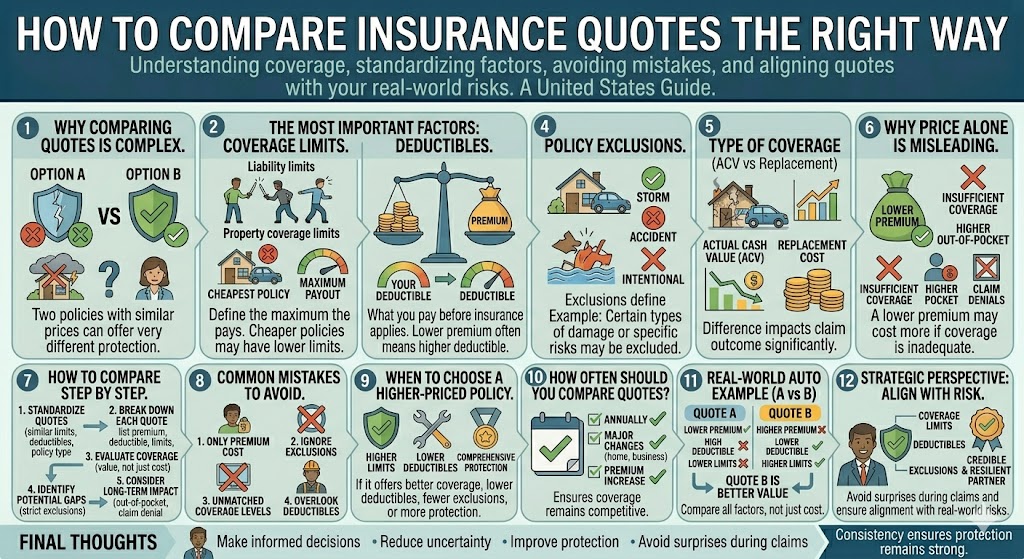
Comparing insurance quotes is one of the most important steps when choosing coverage. However, many people focus only on price — and that is where mistakes happen.
A lower premium does not always mean better value. In some cases, it may indicate less coverage, higher deductibles, or important exclusions that only become clear when a claim is filed.
Understanding how to compare insurance quotes the right way helps ensure that you are not just saving money, but also protecting yourself effectively.
This guide explains how to evaluate insurance quotes properly so you can make informed and confident decisions.
This article is for informational purposes only and does not constitute financial or insurance advice.
Why Comparing Insurance Quotes Is More Complex Than It Seems
At first glance, comparing quotes appears simple:
- Option A costs less
- Option B costs more
But insurance is not a standardized product.
Each quote may differ in:
- Coverage limits
- Deductibles
- Exclusions
- Policy conditions
Two policies with similar prices can offer very different levels of protection.
The Most Important Factors to Compare
1. Coverage Limits
Coverage limits define the maximum amount the insurer will pay.
When comparing quotes, check:
- Liability limits
- Property coverage limits
- Total maximum payouts
A cheaper policy may have lower limits, which could leave you exposed.
2. Deductibles
The deductible is what you pay out of pocket before insurance applies.
Compare:
- Deductible amounts
- How they affect premiums
A lower premium often comes with a higher deductible.
3. Policy Exclusions
Exclusions are one of the most overlooked aspects.
They define what is NOT covered.
Examples may include:
- Certain types of damage
- Specific risks
- Gradual vs sudden events
Always review exclusions carefully.
4. Type of Coverage (Actual Cash Value vs Replacement Cost)
Policies may differ in how they calculate payouts.
- Actual Cash Value (ACV): depreciated value
- Replacement Cost: cost to replace without depreciation
This difference can significantly impact claim outcomes.
5. Policy Conditions
Conditions define how the policy works.
This may include:
- Reporting requirements
- Claim procedures
- Maintenance responsibilities
Ignoring these details can lead to unexpected issues.
6. Additional Coverages and Endorsements
Some policies include optional add-ons.
These may cover:
- Specific risks
- Higher-value items
- Additional protection layers
Make sure you understand what is included — and what is not.
Why Price Alone Is Misleading
Choosing insurance based only on price can lead to:
- Insufficient coverage
- Higher out-of-pocket costs
- Claim denials due to exclusions
A lower premium may actually cost more in the long run if coverage is inadequate.
How to Compare Quotes Step by Step
Step 1: Standardize What You Are Comparing
Ensure that all quotes are based on:
- Similar coverage limits
- Similar deductibles
- Same type of policy
Without this, comparisons are not meaningful.
Step 2: Break Down Each Quote
List key elements for each option:
- Premium
- Deductible
- Coverage limits
- Exclusions
This helps identify differences clearly.
Step 3: Evaluate Coverage vs Cost
Ask:
- What am I getting for this price?
- Where are the differences?
Focus on value, not just cost.
Step 4: Identify Potential Gaps
Look for areas where coverage may be lacking.
Examples:
- Low liability limits
- Missing coverage types
- Strict exclusions
Step 5: Consider Long-Term Impact
Think beyond the premium:
- What happens if I file a claim?
- How much would I pay out of pocket?
This perspective is essential.
Real-World Example
Imagine two auto insurance quotes:
Quote A:
- Lower premium
- High deductible
- Lower liability limits
Quote B:
- Slightly higher premium
- Lower deductible
- Higher liability limits
At first glance, Quote A seems better.
However:
- In case of an accident, out-of-pocket costs may be higher
- Liability protection may be insufficient
In this scenario, Quote B may offer better overall value.
Common Mistakes When Comparing Insurance Quotes
1. Looking Only at the Premium
This is the most common mistake.
2. Ignoring Exclusions
Exclusions can significantly affect coverage.
3. Not Matching Coverage Levels
Comparing different levels of coverage leads to incorrect conclusions.
4. Overlooking Deductibles
Higher deductibles can offset lower premiums.
5. Not Reading Policy Details
Important differences are often found in the fine print.
When It Makes Sense to Choose a Higher-Priced Policy
A higher-priced policy may be justified if it offers:
- Better coverage limits
- Lower deductibles
- Fewer exclusions
- More comprehensive protection
The goal is not to choose the cheapest option, but the most efficient one.
How Often Should You Compare Insurance Quotes?
It is generally a good idea to compare quotes:
- Once a year
- After major life or business changes
- When premiums increase
Regular comparison helps ensure that your coverage remains competitive.
The Strategic Perspective
Comparing insurance quotes is not just about shopping — it is about decision-making.
A well-informed comparison helps:
- Optimize cost
- Improve protection
- Avoid surprises during claims
For businesses, it can also impact financial stability and risk management.
Final Thoughts
Insurance is not a one-size-fits-all product, and comparing quotes requires more than looking at price.
By evaluating coverage limits, deductibles, exclusions, and policy structure, you can make smarter decisions that balance cost and protection.
Taking the time to compare quotes the right way ensures that your insurance works when you need it — not just when you buy it.
In the long run, informed decisions lead to better protection and greater financial confidence.