
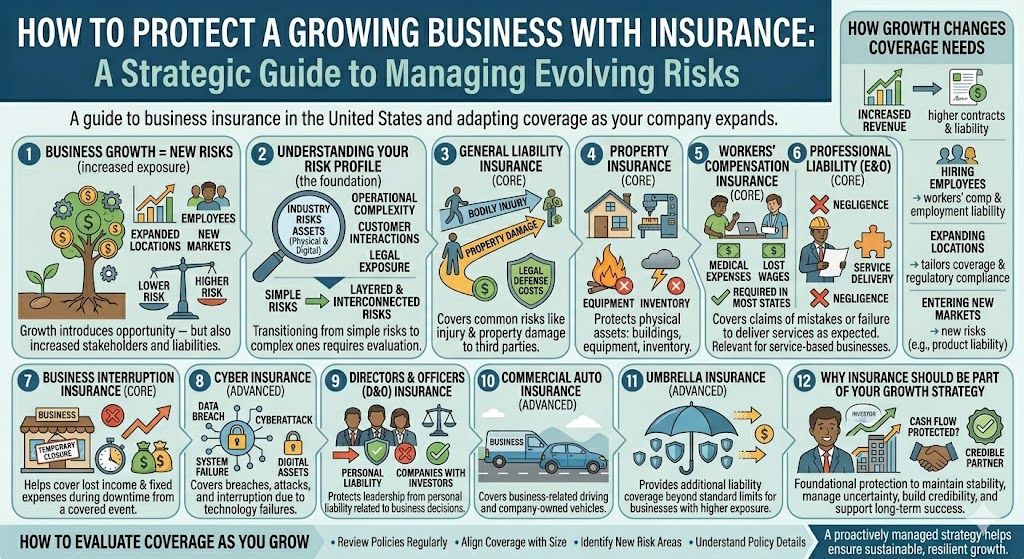
As a business grows, its risks evolve. What may have started as a small operation with limited exposure can quickly expand into a more complex structure with financial, legal, and operational risks.
Insurance plays a critical role in protecting that growth. However, many business owners underestimate how their coverage needs change over time.
Understanding how to protect a growing business with insurance is essential for maintaining stability, managing risk, and supporting long-term success.
This guide explains the key considerations for business insurance in the United States and how coverage should adapt as your company expands.
This article is for informational purposes only and does not constitute financial, legal, or insurance advice.
Why Growing Businesses Face New Risks
Growth introduces opportunity — but also increased exposure.
As a business expands, it may face:
- Higher revenue and financial stakes
- More employees
- Expanded operations
- New locations or markets
- Increased customer interactions
- Greater legal and regulatory responsibilities
Each of these factors can increase risk in different ways.
Insurance must evolve alongside the business.
The Foundation: Understanding Your Risk Profile
Before choosing or updating insurance, it is important to understand your business risk profile.
This includes evaluating:
- Industry-specific risks
- Operational complexity
- Physical and digital assets
- Customer interactions
- Legal exposure
A growing business typically transitions from simple risks to more layered and interconnected ones.
Core Insurance Types for Growing Businesses
While needs vary by industry, several types of insurance form the foundation of business protection.
1. General Liability Insurance
This covers common risks such as:
- Bodily injury claims
- Property damage to third parties
- Legal defense costs
As your business grows and interacts with more customers, exposure increases.
2. Property Insurance
Protects physical assets such as:
- Buildings
- Equipment
- Inventory
Growth often means more assets — and therefore greater potential loss.
3. Workers’ Compensation Insurance
Required in most states for businesses with employees.
Covers:
- Workplace injuries
- Medical expenses
- Lost wages
As your workforce expands, this becomes increasingly important.
4. Professional Liability Insurance
Also known as errors and omissions (E&O) insurance.
Covers:
- Claims of negligence
- Professional mistakes
- Failure to deliver services as expected
Particularly relevant for service-based businesses.
5. Business Interruption Insurance
Helps cover lost income if operations are disrupted due to a covered event.
This may include:
- Temporary closure
- Reduced operations
- Fixed expenses during downtime
For growing businesses, interruptions can have a larger financial impact.
Advanced Coverage for Expanding Businesses
As your business becomes more complex, additional coverage types may be necessary.
1. Cyber Insurance
With increased reliance on technology, businesses face digital risks.
Cyber insurance may cover:
- Data breaches
- Cyberattacks
- Business interruption due to system failures
This is especially relevant for tech-driven or online businesses.
2. Directors and Officers (D&O) Insurance
Protects company leadership from personal liability related to business decisions.
Important for:
- Companies with investors
- Rapidly scaling startups
- Businesses with formal governance structures
3. Commercial Auto Insurance
If your business uses vehicles for operations, personal auto policies may not apply.
Commercial policies cover:
- Business-related driving
- Company-owned vehicles
4. Umbrella Insurance
Provides additional liability coverage beyond standard policy limits.
Useful for businesses with:
- Higher exposure
- Larger contracts
- Increased legal risk
How Growth Changes Insurance Needs
1. Increased Revenue = Increased Risk
Higher revenue often means:
- Larger contracts
- Greater liability
- Higher expectations
Coverage limits should reflect this.
2. Hiring Employees
Expanding your team introduces:
- Workplace injury risk
- Employment-related liability
- Compliance requirements
Insurance must adapt accordingly.
3. Expanding Locations
Operating in multiple locations may introduce:
- Different regulatory requirements
- New environmental risks
- Additional property exposure
Each location may require tailored coverage.
4. Entering New Markets
New products or services can create new types of risk.
Examples:
- Product liability
- Professional liability
- Regulatory compliance
Coverage should reflect these changes.
Common Mistakes Growing Businesses Make
1. Keeping the Same Coverage as When Starting
Many businesses fail to update policies as they grow.
This can lead to underinsurance.
2. Underestimating Liability Risk
As visibility increases, so does exposure to legal claims.
3. Ignoring Digital Risks
Cyber threats are often overlooked until an incident occurs.
4. Focusing Only on Cost
Choosing lower premiums may reduce protection.
Balance is essential.
How to Evaluate Your Coverage as You Grow
1. Review Policies Regularly
Coverage should be reviewed at least annually or after major changes.
2. Align Coverage with Business Size
Ensure policy limits reflect current operations and revenue.
3. Identify New Risk Areas
Growth often introduces risks that were not present before.
4. Understand Policy Details
Review:
- Exclusions
- Limits
- Conditions
These details affect real-world outcomes.
Real-World Example
Consider a small online business that expands into a larger e-commerce operation.
Initially, it may only require basic liability coverage.
As it grows:
- It stores customer data → cyber risk increases
- It ships products → product liability becomes relevant
- Revenue increases → higher financial exposure
Without updated coverage, the business may face significant risk gaps.
The Role of Technology in Business Insurance
Modern insurance solutions are evolving alongside business growth.
Many insurers now offer:
- Digital policy management
- Real-time risk assessment
- Usage-based pricing models
- Data-driven insights
These tools can help businesses adapt coverage more efficiently.
Why Insurance Should Be Part of Your Growth Strategy
Insurance is often seen as a cost, but it also serves as a strategic asset.
It helps:
- Protect cash flow
- Reduce uncertainty
- Support long-term planning
- Build credibility with partners and investors
For growing businesses, protection is not optional — it is foundational.
Final Thoughts
Protecting a growing business with insurance requires more than simply maintaining existing policies.
As your business evolves, so do your risks. Coverage must adapt to reflect changes in operations, revenue, workforce, and market exposure.
A proactive approach to insurance helps ensure that growth is supported by adequate protection — not undermined by unseen risks.
Understanding your coverage and reviewing it regularly is key to building a resilient and sustainable business.