
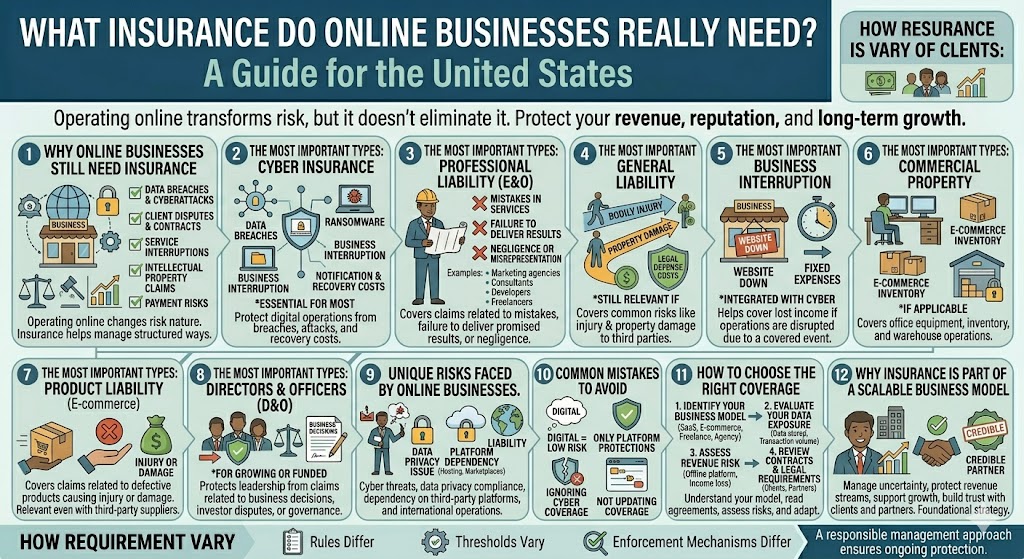
Online businesses have transformed how products and services are created, sold, and delivered. From e-commerce stores to SaaS platforms and digital agencies, operating online offers flexibility and scalability — but it also introduces unique risks.
Many online business owners assume that working digitally reduces the need for insurance. In reality, the opposite is often true. Digital operations create new types of exposure that traditional policies may not fully cover.
Understanding what insurance online businesses really need is essential for protecting revenue, reputation, and long-term growth.
This guide explains the most relevant types of insurance for online businesses in the United States and how to approach coverage strategically.
This article is for informational purposes only and does not constitute legal or insurance advice.
Why Online Businesses Still Need Insurance
Even without a physical storefront, online businesses face multiple risks.
These may include:
- Data breaches and cyberattacks
- Client disputes or contract issues
- Service interruptions
- Intellectual property claims
- Payment processing risks
Operating online does not eliminate risk — it changes its nature.
Insurance helps manage these risks in a structured way.
The Most Important Insurance Types for Online Businesses
1. Cyber Insurance (Essential for Most Online Businesses)
Cyber insurance is one of the most important coverages for digital operations.
It may cover:
- Data breaches
- Hacking incidents
- Ransomware attacks
- Business interruption due to cyber events
- Notification and recovery costs
Any business that stores customer data or operates online should evaluate this coverage carefully.
2. Professional Liability Insurance (Errors & Omissions)
This is critical for service-based online businesses.
It covers claims related to:
- Mistakes in services
- Failure to deliver promised results
- Negligence or misrepresentation
Examples include:
- Marketing agencies
- Consultants
- Developers
- Freelancers
Even small errors can lead to financial disputes.
3. General Liability Insurance
While often associated with physical businesses, general liability can still apply.
It may cover:
- Third-party claims of injury or damage
- Legal defense costs
For example, if you meet clients in person or attend events, this coverage may still be relevant.
4. Business Interruption Insurance
Online businesses rely heavily on continuous operations.
This coverage may help if:
- Your website goes down due to a covered event
- Operations are disrupted
- Revenue is temporarily lost
Some policies may integrate this with cyber insurance.
5. Commercial Property Insurance (If Applicable)
Not all online businesses need this, but it applies if you have:
- Office equipment
- Inventory
- Warehousing operations
E-commerce businesses with physical inventory should consider this carefully.
6. Product Liability Insurance (For E-commerce)
If you sell physical products, this becomes important.
It covers:
- Claims related to defective products
- Injury or damage caused by products
Even if you use third-party suppliers, liability may still apply.
7. Directors and Officers (D&O) Insurance
For growing or funded online businesses, D&O insurance may be relevant.
It protects leadership from claims related to:
- Business decisions
- Investor disputes
- Governance issues
This is especially important for startups and scaling companies.
Unique Risks Faced by Online Businesses
1. Cybersecurity Threats
Online businesses are frequent targets of:
- Phishing attacks
- Malware
- Data breaches
These risks can lead to financial and reputational damage.
2. Data Privacy Issues
Handling customer data introduces compliance responsibilities.
Violations may lead to:
- Legal action
- Regulatory penalties
- Loss of customer trust
3. Platform Dependency
Many online businesses rely on platforms such as:
- Payment processors
- Hosting services
- Marketplaces
Disruptions in these services can impact operations.
4. Global Exposure
Online businesses often operate across borders.
This may introduce:
- Different legal environments
- International liability risks
- Currency and transaction issues
Common Mistakes Online Businesses Make
1. Assuming “Digital = Low Risk”
Many founders underestimate digital exposure.
2. Relying Only on Platform Protections
Third-party platforms may offer limited protection, but they do not replace insurance.
3. Ignoring Cyber Coverage
Cyber risk is one of the most significant threats for online operations.
4. Not Updating Coverage as the Business Grows
As revenue and operations expand, risks increase.
How to Choose the Right Coverage
1. Identify Your Business Model
Different models require different coverage:
- SaaS
- E-commerce
- Freelance services
- Digital agencies
2. Evaluate Your Data Exposure
Consider:
- Type of data stored
- Volume of transactions
- Security measures in place
3. Assess Revenue Risk
Ask:
- What happens if your platform goes offline?
- How long can your business operate without income?
4. Review Contracts and Legal Requirements
Clients or partners may require specific coverage.
Real-World Example
Consider a small online marketing agency.
Initially, it may operate with minimal risk.
As it grows:
- It manages client accounts → professional liability increases
- It stores client data → cyber risk increases
- It signs contracts → legal exposure increases
Without proper coverage, a single dispute or incident could have significant financial consequences.
The Role of Technology in Insurance for Online Businesses
Insurance providers are increasingly adapting to digital models.
New solutions may include:
- On-demand coverage
- Usage-based pricing
- Integrated cyber protection
- Digital risk monitoring
These tools allow online businesses to align coverage more closely with their operations.
Why Insurance Is Part of a Scalable Business Model
Insurance is not just protection — it is part of building a scalable and resilient business.
It helps:
- Manage uncertainty
- Protect revenue streams
- Support growth
- Build trust with clients and partners
For online businesses, this is especially important due to the fast-paced and interconnected nature of digital operations.
Final Thoughts
Online businesses operate in a dynamic environment where risks are often less visible but equally significant.
From cyber threats to contractual disputes, digital operations require a thoughtful approach to insurance.
Understanding what coverage is needed — and adapting it as your business grows — helps ensure that innovation is supported by protection.
Insurance is not just for traditional businesses. In the digital economy, it is a critical component of sustainable growth.