
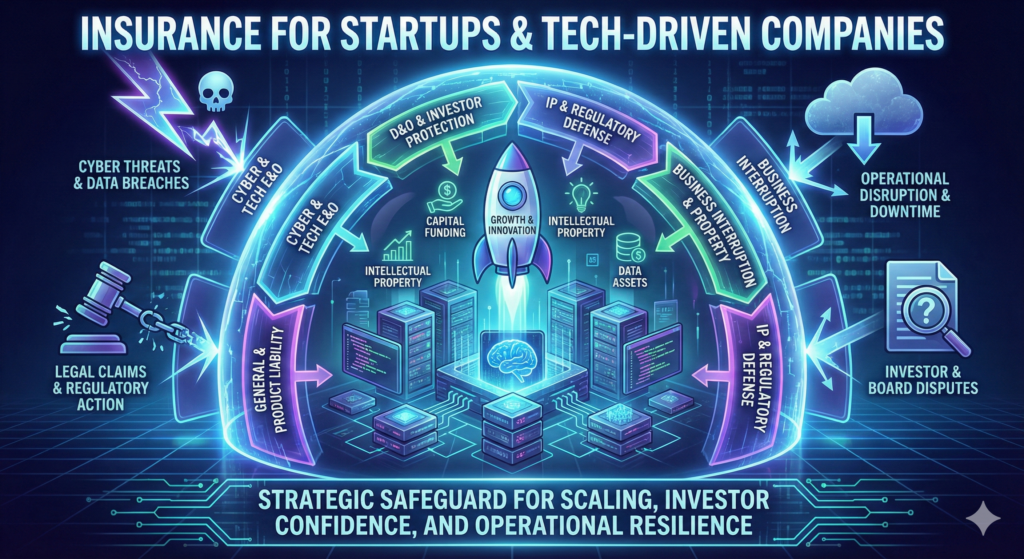
Startups and technology-driven companies operate in fast-moving, high-innovation environments. Unlike traditional businesses, they often scale rapidly, manage sensitive digital data, rely on intellectual property, and operate with lean teams.
While founders frequently focus on product development, funding, and market expansion, insurance is sometimes treated as a secondary concern. However, for startups — especially in the technology sector — insurance is not merely a compliance requirement. It is a strategic safeguard that protects growth, investor confidence, and operational stability.
Understanding the insurance needs of startups and tech-driven companies requires recognizing the unique risks these organizations face.
Why Startups Face Unique Risk Exposure
Startups differ from established businesses in several ways:
- Limited operating history
- Rapid scaling
- Heavy reliance on intellectual property
- Technology-based service delivery
- Venture capital involvement
- Lean operational structures
These characteristics create a distinct risk profile.
For example, a software-as-a-service (SaaS) company may not own physical inventory, but it handles sensitive client data. A fintech startup may face regulatory scrutiny. A biotech company may encounter product liability concerns.
Insurance planning for startups must reflect these modern exposure categories.
General Liability Insurance
General liability insurance is often considered foundational coverage.
It typically addresses claims involving:
- Bodily injury
- Property damage
- Advertising injury
- Legal defense costs
Even technology companies with minimal physical operations may face third-party claims related to office visitors or client interactions.
Additionally, many commercial leases and client contracts require proof of general liability coverage.
For startups entering partnerships or leasing office space, this coverage often serves as an entry requirement.
Professional Liability (Errors & Omissions)
Professional liability insurance — also known as Errors & Omissions (E&O) insurance — is particularly relevant for tech-driven companies.
This coverage addresses claims alleging:
- Negligence
- Service errors
- Software failures
- Failure to meet contractual obligations
For example, if a platform outage causes financial loss to a client, professional liability coverage may respond, depending on policy terms.
Technology startups that provide consulting, development, or cloud-based services often rely on E&O coverage as a core component of risk management.
Cyber Insurance
Cyber insurance has become increasingly important for startups operating in digital ecosystems.
Technology companies frequently collect, process, or store:
- Customer data
- Payment information
- Intellectual property
- Confidential business information
Cyber insurance may address:
- Data breach response costs
- Incident investigation
- Legal defense
- Regulatory compliance support
- Business interruption related to cyber events
Investors and enterprise clients increasingly expect startups to maintain cyber coverage, especially when handling sensitive data.
Cyber risk is not theoretical — it is operational.
Directors and Officers (D&O) Insurance
Startups seeking venture capital funding often require Directors and Officers (D&O) insurance.
D&O insurance addresses claims made against company leadership related to:
- Mismanagement allegations
- Fiduciary duty disputes
- Investor-related claims
- Regulatory actions
Venture capital firms frequently require D&O coverage as part of funding agreements.
For founders and board members, D&O insurance protects personal assets from certain management-related claims.
This coverage is particularly relevant as startups grow and governance structures become more complex.
Employment Practices Liability Insurance (EPLI)
As startups hire employees, employment-related risk increases.
Employment Practices Liability Insurance (EPLI) may address claims involving:
- Wrongful termination
- Discrimination
- Harassment
- Retaliation
Even early-stage startups can face employment-related disputes.
Maintaining clear HR policies and appropriate insurance coverage supports organizational stability.
Business Interruption Insurance
Although many tech companies operate digitally, they are not immune to operational disruption.
Business interruption insurance may help address income loss resulting from covered events such as:
- Property damage
- System outages (depending on policy terms)
- Operational shutdowns
For startups dependent on continuous uptime, financial resilience planning is essential.
Understanding how interruption coverage applies to digital operations is critical when reviewing policies.
Intellectual Property Considerations
Intellectual property (IP) is often a startup’s most valuable asset.
Patent disputes, copyright issues, and trademark conflicts can result in legal expenses.
While not all policies automatically cover IP disputes, certain specialized endorsements or policies may address aspects of intellectual property risk.
Tech founders should carefully review exclusions and policy language related to IP.
Insurance as a Funding Requirement
Investors frequently evaluate risk management structures before committing capital.
Insurance coverage can signal:
- Operational maturity
- Governance responsibility
- Financial foresight
Certain funding rounds may require minimum coverage levels, particularly for D&O and cyber insurance.
Insurance becomes part of the due diligence process.
It is not merely protection — it can influence credibility.
Contractual Insurance Obligations
Startups entering enterprise contracts may encounter insurance requirements such as:
- Minimum liability limits
- Certificates of insurance
- Additional insured endorsements
Failing to meet these requirements can delay partnerships or contracts.
Understanding contractual insurance obligations ensures smoother business development.
Risk Management Beyond Insurance
While insurance plays a key role, startups should also prioritize preventive risk management.
Examples include:
- Implementing cybersecurity best practices
- Maintaining clear contractual language
- Establishing internal compliance procedures
- Creating documented operational protocols
Insurance complements — but does not replace — structured risk management.
Insurers may also evaluate preventive measures during underwriting.
Balancing Cost and Coverage
Startups often operate with limited budgets.
Balancing premium costs with adequate coverage is essential.
Strategies may include:
- Selecting appropriate deductibles
- Bundling policies where feasible
- Reviewing coverage annually
- Prioritizing high-exposure areas
Reducing coverage to cut costs may create exposure that outweighs short-term savings.
Insurance decisions should reflect risk severity rather than budget constraints alone.
The Role of Brokers and Advisors
Given the complexity of startup risk exposure, working with experienced insurance brokers or advisors may provide value.
Advisors can:
- Identify coverage gaps
- Interpret policy exclusions
- Compare multiple carriers
- Align coverage with funding stages
As startups evolve, insurance needs change.
Professional guidance can support structured growth.
Technology-Driven Risk Evolution
Tech-driven companies face rapidly evolving risk landscapes.
Emerging risks may include:
- AI liability
- Data governance compliance
- Cross-border digital regulation
- Platform dependency risks
Insurance products continue to adapt to these modern exposures.
Staying informed about emerging risks ensures that coverage remains relevant.
Conclusion
Insurance for startups and tech-driven companies is not simply about compliance. It is a strategic component of operational resilience, investor confidence, and sustainable growth.
From general liability and professional liability to cyber and D&O coverage, startups face a diverse set of exposures that require thoughtful evaluation.
As technology continues to reshape industries, startups must approach insurance as part of their foundational infrastructure — protecting assets, leadership, and long-term viability.
Proactive insurance planning supports innovation by reducing uncertainty in an inherently dynamic environment.