
The Invisible Mistake That Makes Your Best Salesperson the Least Profitable
At first, it sounds like a contradiction.
How can your best salesperson—the one closing the most deals, hitting targets every month, and bringing in the highest revenue—actually be one of the least profitable people in your entire organization?
But in insurance sales, this happens more often than most managers are willing to admit.
And the reason is simple: we confuse productivity with profitability, and speed with quality.
This article breaks down how that distortion happens, why it persists in insurance teams, and what it actually costs your business over time.
A scenario that looks like success (but isn’t)
Let’s imagine a typical insurance agency with a small high-performing team.
At the end of the quarter, leadership reviews the performance report:
| Agent | Policies Sold | Total Revenue | Avg Discount | Cancellation Rate (60 days) |
|---|---|---|---|---|
| A | 72 | €58,400 | 14% | 22% |
| B | 55 | €51,200 | 8% | 12% |
| C | 61 | €54,000 | 10% | 15% |
| D | 49 | €47,800 | 5% | 9% |
Agent A stands out immediately.
- Highest number of policies sold
- Highest total revenue
- Strong pipeline velocity
On a standard dashboard, Agent A looks like the clear “winner”.
In many companies, this is the person who gets:
- Bonuses
- Recognition
- Better leads
- Promotion discussions
But when you zoom out to profitability, a different picture appears.
The profitability breakdown nobody runs at first glance
Let’s add one missing layer: net profit per agent portfolio.
We’ll assume simplified costs:
- Acquisition cost per policy
- Support cost per client
- Early cancellation loss
| Agent | Gross Revenue | Estimated Costs | Early Cancellations Loss | Net Profit |
|---|---|---|---|---|
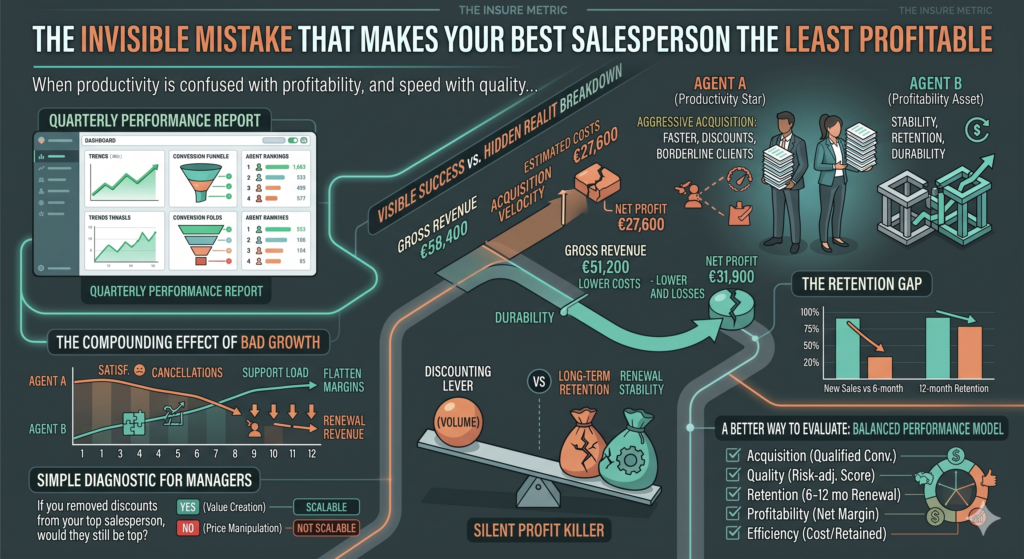
| A | €58,400 | €21,000 | €9,800 | €27,600 |
| B | €51,200 | €15,200 | €4,100 | €31,900 |
| C | €54,000 | €17,000 | €5,300 | €31,700 |
| D | €47,800 | €13,500 | €3,200 | €31,100 |
Now the story changes completely.
Agent A—the top performer by almost every “visible” metric—is actually the least profitable agent in the team.
So what’s happening?
The hidden driver: aggressive acquisition behavior
In most insurance teams, top sellers often rely on a similar pattern:
- Faster closing cycles
- Heavier discounting
- Lower qualification thresholds
- Higher acceptance of borderline clients
This produces immediate results:
- More policies sold
- Faster monthly target achievement
- Higher short-term revenue
But it also creates long-term friction:
- Clients with higher churn probability
- Increased claims processing load
- Lower lifetime value per customer
- More administrative overhead
In other words:
The faster you grow, the more hidden cost you accumulate.
Why discounting is the silent profit killer
Let’s isolate one of the most important variables: discount rate.
| Discount Level | Conversion Rate | Cancellation Rate | Net Profit Impact |
|---|---|---|---|
| 5% | Medium | Low | High stability |
| 10% | High | Medium | Balanced |
| 15% | Very High | High | Low profitability |
At first glance, discounting seems like a growth lever.
And it is—but only for volume.
What it quietly destroys is:
- Customer quality perception
- Long-term retention
- Price anchoring
- Renewal stability
A salesperson like Agent A often becomes “the closer” because they remove friction from the sale.
But friction in insurance is not always bad.
Sometimes, friction is filtering out the wrong customers.
The retention gap that hides in plain sight
Most dashboards track:
- New sales
- Monthly revenue
- Conversion rates
Very few track:
- Retention quality per agent
- Lifetime value per acquisition channel
- Cancellation reason clusters
Let’s visualize the problem:
| Agent | New Sales | 6-Month Retention | 12-Month Retention | Avg Customer Value |
|---|---|---|---|---|
| A | 72 | 68% | 54% | €810 |
| B | 55 | 82% | 74% | €1,020 |
| C | 61 | 79% | 71% | €980 |
| D | 49 | 85% | 80% | €1,050 |
Agent A wins on acquisition.
But loses on durability.
And in insurance, durability is where profit actually lives.
Why organizations keep rewarding the wrong behavior
Even when leadership sees these patterns, the system often doesn’t change.
Why?
Because incentive structures are usually built around simplicity, not accuracy.
Most bonus systems prioritize:
- Sales volume
- Monthly revenue
- New client acquisition
Why? Because these are:
- Easy to measure
- Easy to compare
- Easy to communicate
But they ignore:
- Long-term profitability
- Customer stability
- Portfolio health
So the system reinforces exactly the wrong behavior:
“Do more of what looks good now.”
The compounding effect of “bad growth”
The real damage doesn’t appear immediately.
It compounds over time.
Month 1–3:
- Revenue increases
- Leadership is satisfied
- Sales team morale is high
Month 4–8:
- Cancellation rates begin to rise
- Support workload increases
- Margins start to flatten
Month 9–12:
- Renewal revenue drops
- Customer complaints increase
- Acquisition cost rises (because churn must be replaced)
By the time the issue is visible, it is already systemic.
A better way to evaluate “top performers”
Instead of asking:
“Who sold the most?”
You should be asking:
“Who created the most sustainable revenue?”
A more balanced performance model includes:
| Dimension | Metric |
|---|---|
| Acquisition | Qualified conversion rate |
| Quality | Risk-adjusted client score |
| Retention | 6–12 month renewal rate |
| Profitability | Net margin per portfolio |
| Efficiency | Cost per retained customer |
When you combine these, rankings often change completely.
Your “top seller” may move to mid-table.
And a quiet, consistent performer becomes your most valuable asset.
The psychological trap of high performers
There is also a behavioral layer to this.
High-performing agents are often rewarded early in their careers for:
- Speed
- Volume
- Closing ability
So they internalize a simple rule:
“The faster I sell, the better I perform.”
But insurance is not a pure sales environment.
It is a lifecycle optimization environment.
This creates a mismatch between:
- what individuals optimize for
- and what the business actually needs
What happens when you fix the system
When companies adjust incentives to include retention and profitability:
- Discounting decreases naturally
- Client quality improves
- Portfolio stability increases
- Long-term revenue becomes more predictable
Importantly:
Sales do not necessarily drop.
What changes is sales composition.
Instead of:
- More low-quality policies
You get:
- Fewer but higher-value, longer-lasting policies
A simple diagnostic question for any manager
If you are managing an insurance team, ask yourself:
If I removed discounts from my top salesperson, would they still be top?
If the answer is no, then:
- performance is being driven by price manipulation
- not value creation
And that is not scalable.
Final thought
The uncomfortable reality in insurance sales is this:
Your best salesperson is not always your most profitable asset.
Sometimes, they are simply the most efficient at optimizing the wrong metric.
And when that happens, the system rewards behavior that looks like success—but quietly erodes the foundation of your business.
Real performance in insurance is not about who sells the most.
It is about who sells the right policies to the right clients—and keeps them long enough for value to compound.At first, it sounds like a contradiction.
How can your best salesperson—the one closing the most deals, hitting targets every month, and bringing in the highest revenue—actually be one of the least profitable people in your entire organization?
But in insurance sales, this happens more often than most managers are willing to admit.
And the reason is simple: we confuse productivity with profitability, and speed with quality.
This article breaks down how that distortion happens, why it persists in insurance teams, and what it actually costs your business over time.
A scenario that looks like success (but isn’t)
Let’s imagine a typical insurance agency with a small high-performing team.
At the end of the quarter, leadership reviews the performance report:
| Agent | Policies Sold | Total Revenue | Avg Discount | Cancellation Rate (60 days) |
|---|---|---|---|---|
| A | 72 | €58,400 | 14% | 22% |
| B | 55 | €51,200 | 8% | 12% |
| C | 61 | €54,000 | 10% | 15% |
| D | 49 | €47,800 | 5% | 9% |
Agent A stands out immediately.
- Highest number of policies sold
- Highest total revenue
- Strong pipeline velocity
On a standard dashboard, Agent A looks like the clear “winner”.
In many companies, this is the person who gets:
- Bonuses
- Recognition
- Better leads
- Promotion discussions
But when you zoom out to profitability, a different picture appears.
The profitability breakdown nobody runs at first glance
Let’s add one missing layer: net profit per agent portfolio.
We’ll assume simplified costs:
- Acquisition cost per policy
- Support cost per client
- Early cancellation loss
| Agent | Gross Revenue | Estimated Costs | Early Cancellations Loss | Net Profit |
|---|---|---|---|---|
| A | €58,400 | €21,000 | €9,800 | €27,600 |
| B | €51,200 | €15,200 | €4,100 | €31,900 |
| C | €54,000 | €17,000 | €5,300 | €31,700 |
| D | €47,800 | €13,500 | €3,200 | €31,100 |
Now the story changes completely.
Agent A—the top performer by almost every “visible” metric—is actually the least profitable agent in the team.
So what’s happening?
The hidden driver: aggressive acquisition behavior
In most insurance teams, top sellers often rely on a similar pattern:
- Faster closing cycles
- Heavier discounting
- Lower qualification thresholds
- Higher acceptance of borderline clients
This produces immediate results:
- More policies sold
- Faster monthly target achievement
- Higher short-term revenue
But it also creates long-term friction:
- Clients with higher churn probability
- Increased claims processing load
- Lower lifetime value per customer
- More administrative overhead
In other words:
The faster you grow, the more hidden cost you accumulate.
Why discounting is the silent profit killer
Let’s isolate one of the most important variables: discount rate.
| Discount Level | Conversion Rate | Cancellation Rate | Net Profit Impact |
|---|---|---|---|
| 5% | Medium | Low | High stability |
| 10% | High | Medium | Balanced |
| 15% | Very High | High | Low profitability |
At first glance, discounting seems like a growth lever.
And it is—but only for volume.
What it quietly destroys is:
- Customer quality perception
- Long-term retention
- Price anchoring
- Renewal stability
A salesperson like Agent A often becomes “the closer” because they remove friction from the sale.
But friction in insurance is not always bad.
Sometimes, friction is filtering out the wrong customers.
The retention gap that hides in plain sight
Most dashboards track:
- New sales
- Monthly revenue
- Conversion rates
Very few track:
- Retention quality per agent
- Lifetime value per acquisition channel
- Cancellation reason clusters
Let’s visualize the problem:
| Agent | New Sales | 6-Month Retention | 12-Month Retention | Avg Customer Value |
|---|---|---|---|---|
| A | 72 | 68% | 54% | €810 |
| B | 55 | 82% | 74% | €1,020 |
| C | 61 | 79% | 71% | €980 |
| D | 49 | 85% | 80% | €1,050 |
Agent A wins on acquisition.
But loses on durability.
And in insurance, durability is where profit actually lives.
Why organizations keep rewarding the wrong behavior
Even when leadership sees these patterns, the system often doesn’t change.
Why?
Because incentive structures are usually built around simplicity, not accuracy.
Most bonus systems prioritize:
- Sales volume
- Monthly revenue
- New client acquisition
Why? Because these are:
- Easy to measure
- Easy to compare
- Easy to communicate
But they ignore:
- Long-term profitability
- Customer stability
- Portfolio health
So the system reinforces exactly the wrong behavior:
“Do more of what looks good now.”
The compounding effect of “bad growth”
The real damage doesn’t appear immediately.
It compounds over time.
Month 1–3:
- Revenue increases
- Leadership is satisfied
- Sales team morale is high
Month 4–8:
- Cancellation rates begin to rise
- Support workload increases
- Margins start to flatten
Month 9–12:
- Renewal revenue drops
- Customer complaints increase
- Acquisition cost rises (because churn must be replaced)
By the time the issue is visible, it is already systemic.
A better way to evaluate “top performers”
Instead of asking:
“Who sold the most?”
You should be asking:
“Who created the most sustainable revenue?”
A more balanced performance model includes:
| Dimension | Metric |
|---|---|
| Acquisition | Qualified conversion rate |
| Quality | Risk-adjusted client score |
| Retention | 6–12 month renewal rate |
| Profitability | Net margin per portfolio |
| Efficiency | Cost per retained customer |
When you combine these, rankings often change completely.
Your “top seller” may move to mid-table.
And a quiet, consistent performer becomes your most valuable asset.
The psychological trap of high performers
There is also a behavioral layer to this.
High-performing agents are often rewarded early in their careers for:
- Speed
- Volume
- Closing ability
So they internalize a simple rule:
“The faster I sell, the better I perform.”
But insurance is not a pure sales environment.
It is a lifecycle optimization environment.
This creates a mismatch between:
- what individuals optimize for
- and what the business actually needs
What happens when you fix the system
When companies adjust incentives to include retention and profitability:
- Discounting decreases naturally
- Client quality improves
- Portfolio stability increases
- Long-term revenue becomes more predictable
Importantly:
Sales do not necessarily drop.
What changes is sales composition.
Instead of:
- More low-quality policies
You get:
- Fewer but higher-value, longer-lasting policies
A simple diagnostic question for any manager
If you are managing an insurance team, ask yourself:
If I removed discounts from my top salesperson, would they still be top?
If the answer is no, then:
- performance is being driven by price manipulation
- not value creation
And that is not scalable.
Final thought
The uncomfortable reality in insurance sales is this:
Your best salesperson is not always your most profitable asset.
Sometimes, they are simply the most efficient at optimizing the wrong metric.
And when that happens, the system rewards behavior that looks like success—but quietly erodes the foundation of your business.
Real performance in insurance is not about who sells the most.
It is about who sells the right policies to the right clients—and keeps them long enough for value to compound.