
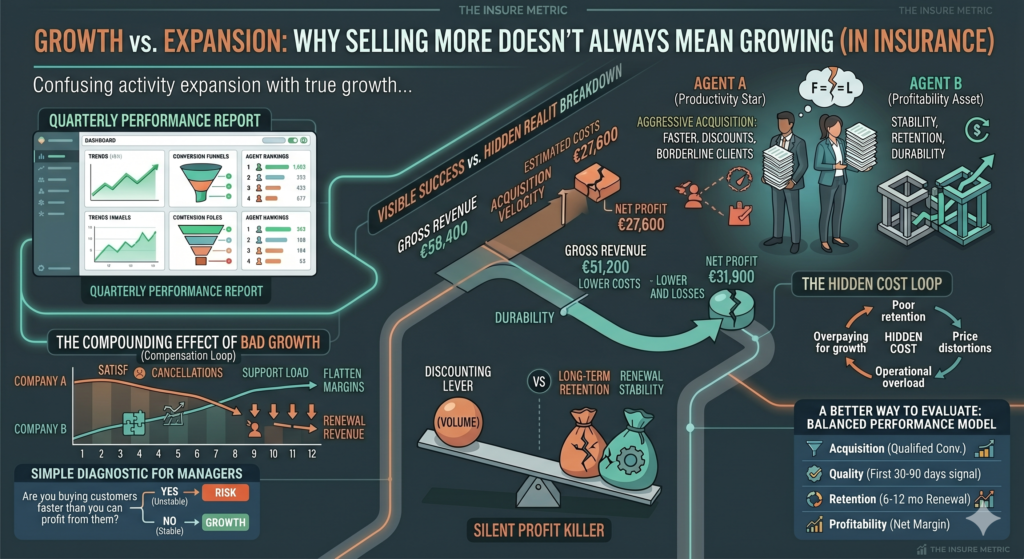
In most insurance companies, growth is defined in one very simple way:
More sales equals more growth.
It sounds logical. Even intuitive.
If you sell more policies this month than last month, the business is growing. If revenue increases, the business is healthy. If conversion improves, the strategy is working.
But insurance is one of those industries where this logic breaks quietly—and often dangerously.
Because selling more can absolutely coexist with:
- lower profitability
- weaker retention
- higher operational costs
- and a deteriorating customer portfolio
And when that happens, what looks like growth is actually something else:
activity expansion masking structural decline.
The story that looks like success
Let’s imagine a mid-sized insurance agency.
Over three months, leadership sees this trend:
| Month | Policies Sold | Revenue | Conversion Rate |
|---|---|---|---|
| 1 | 1,000 | €420,000 | 18% |
| 2 | 1,200 | €480,000 | 20% |
| 3 | 1,400 | €540,000 | 22% |
On paper, this is a strong growth trajectory.
The leadership reaction is predictable:
- “Sales are improving”
- “The strategy is working”
- “We should scale this approach”
But this is only one layer of the system.
The visible layer.
The hidden layer: what happens after the sale
Now let’s add delayed indicators:
| Metric | Month 1 | Month 3 |
|---|---|---|
| 60-day churn | 8% | 17% |
| Claims frequency | Stable | Increasing |
| Support cost per client | €12 | €23 |
| Renewal intent | 80% | 63% |
Now the story changes.
Because while sales increased by 40%:
- customer stability decreased
- operational costs increased
- long-term revenue quality declined
This is the key contradiction:
The system is growing in volume but shrinking in quality.
The difference between growth and expansion
A critical distinction in insurance is:
Expansion
- more customers
- more policies
- more activity
- more revenue
Growth (true growth)
- more retained value
- more stable customers
- more predictable profitability
- stronger long-term portfolio
Expansion is easy to measure.
Growth is harder to observe.
And that is why many organizations confuse the two.
Why selling more can degrade your portfolio
When sales volume increases, the system often adapts in unintended ways:
1. Lower qualification standards
To maintain volume:
- more borderline clients are accepted
- risk filters are relaxed
- underwriting pressure increases
2. Increased discounting
To close more deals:
- pricing flexibility increases
- perceived value decreases
- customer quality becomes uneven
3. Faster closing cycles
To hit targets:
- decisions are rushed
- fewer objections are addressed
- mismatches increase
These behaviors improve sales metrics.
But they weaken the portfolio.
The silent accumulation of bad customers
One of the most dangerous effects of aggressive sales growth is portfolio drift.
Let’s simplify it:
| Customer Type | Month 1 Share | Month 6 Share |
|---|---|---|
| High-quality, low-risk | 60% | 40% |
| Medium-quality | 30% | 35% |
| High-risk / low-fit | 10% | 25% |
Even though total sales increased, the composition shifted.
And that shift matters more than volume.
Because insurance profitability depends heavily on:
- retention probability
- claims behavior
- stability of risk exposure
Not just acquisition.
The revenue illusion
Revenue is often treated as the ultimate indicator of growth.
But revenue alone hides critical information.
Let’s compare two scenarios:
| Scenario | Revenue | Retention | Net Profit |
|---|---|---|---|
| A | €500K | 82% | High |
| B | €600K | 61% | Lower |
Scenario B looks better in headline metrics.
But performs worse in actual business stability.
Why?
Because churn erodes future value faster than new sales can replace it.
The compounding problem: churn requires more sales
Once retention starts declining, the system enters a compensation loop:
- customers leave faster
- revenue drops
- leadership pushes for more sales
- sales teams accelerate acquisition
- quality drops further
- churn increases again
This creates a treadmill effect:
You must run faster just to stay in place.
At first, it looks like growth.
But it is actually compensation.
Why “more sales” feels like success even when it isn’t
There is a psychological bias at play:
Visibility bias
Sales are:
- immediate
- measurable
- visible
Retention is:
- delayed
- indirect
- harder to observe
So naturally:
organizations overweight what they can see now.
This is why dashboards often reinforce the wrong interpretation of growth.
The unit economics problem hiding underneath
Selling more is only beneficial if unit economics remain stable.
Let’s break it down:
| Metric | Before | After Sales Increase |
|---|---|---|
| Acquisition cost | €100 | €130 |
| Lifetime value | €320 | €280 |
| Profit per client | €220 | €150 |
Even with more customers:
- each customer becomes less valuable
- margins compress
- profitability declines
So total volume increases, but efficiency decreases.
The quality paradox of scaling sales
As sales scale, three paradoxes often appear:
1. More customers, less value per customer
Growth in quantity hides decline in quality.
2. More revenue, less profit
Operational complexity increases faster than income.
3. More activity, less stability
The system becomes more volatile.
This is why scaling insurance sales is not linear.
It is structural.
The role of incentives in distorted growth
Most insurance sales teams are incentivized on:
- number of policies
- monthly revenue
- short-term targets
This creates predictable behavior:
- prioritize speed
- prioritize easy conversions
- prioritize volume over fit
And the system responds accordingly.
Because:
People optimize exactly what they are rewarded for, not what the business needs long-term.
A real-world pattern: “growth masking degradation”
Many insurance companies experience this pattern:
Phase 1: Growth
- sales increase
- dashboards improve
- leadership confidence rises
Phase 2: Early warning signs
- retention begins to decline
- support load increases
- margins flatten
Phase 3: Structural tension
- churn offsets acquisition
- cost per customer rises
- profitability weakens
Phase 4: Correction pressure
- aggressive sales targets
- discount expansion
- further quality decline
By the time Phase 4 is reached:
growth is no longer growth—it is maintenance.
What real growth actually looks like
In sustainable insurance businesses, growth has different characteristics:
| Dimension | Healthy Growth |
|---|---|
| Revenue | Gradual, stable increase |
| Retention | Improving or stable |
| Customer quality | Consistent or improving |
| Margins | Stable or expanding |
| Sales volume | Balanced with quality |
Importantly:
real growth does not require sacrificing stability.
The key diagnostic question
If you want to understand whether “more sales” equals real growth, ask:
Are we getting better customers, or just more customers?
Because those are not the same thing.
And in insurance, they often move in opposite directions when systems are misaligned.
Final thought
Selling more is not inherently bad.
But in insurance, it is not a sufficient definition of success.
Growth only exists when increased sales translate into sustained value—not just increased activity.
Without that condition, “growth” becomes a measurement artifact rather than a business reality.
And over time, that illusion is what leads companies to believe they are scaling… while their actual performance quietly weakens underneath.